The importance of THINKING for a natural dyer

I am a natural dyer but I also enjoy reading about and cooking food. I was recently perusing Michael Ruhlman’s book, Twenty: 20 Techniques, 100 Recipes. The first chapter is titled “THINK: Where Cooking Begins”. The author talks about the importance of thinking to the cook.  I might say the same thing about the dye kitchen. Dyeing is not just about following a recipe, but thinking about and understanding the role of each of the ingredients.

Ruhlman recognizes that his list of techniques includes many that are also ingredients: salt, acid, sugar… One might say the same thing about our dye ingredients: mordant, acid,  base, or dye plant…  Awareness of what each ingredient contributes to the process is key to understanding how it fits into the larger picture of dyeing.

Let’s talk about mordants – alum specifically.

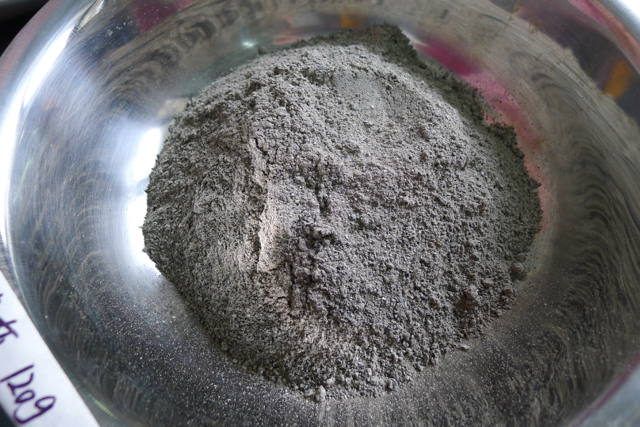
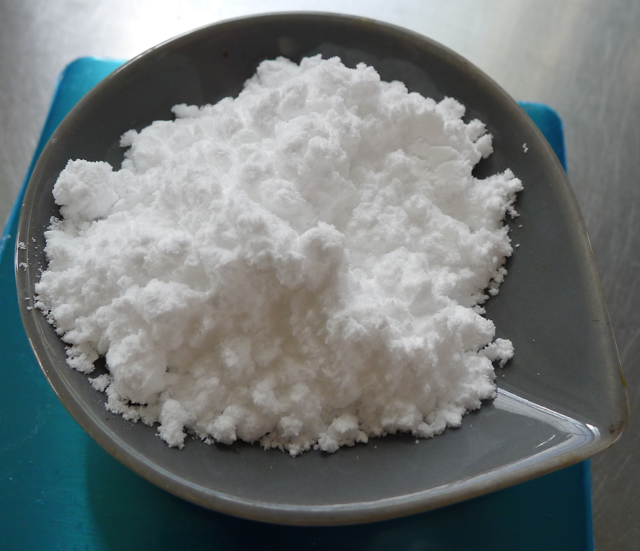
The alum we typically use in the dye studio is potassium aluminum sulfate [KAl(SO4)]. It is most likely made in a laboratory, is in powder or small crystal form, dissolves easily, and contains no contaminants such as iron.
P1080146
Alum (potassium aluminum sulfate) in powder form

Aluminum sulfate [Al2(SO4)3] is made by a different process and may be contaminated with small amounts or iron.  The first dyeing I ever did utilized naturally occurring alum gathered from the ground surface – no telling how impure or contaminated it was.

We often shorten the name of our mordant to simply  “alum” but there are many different types of alum and it may be best to use (and specify) potassium aluminum sulfate. I never purchase from a supplier who cannot provide material with that specific name.

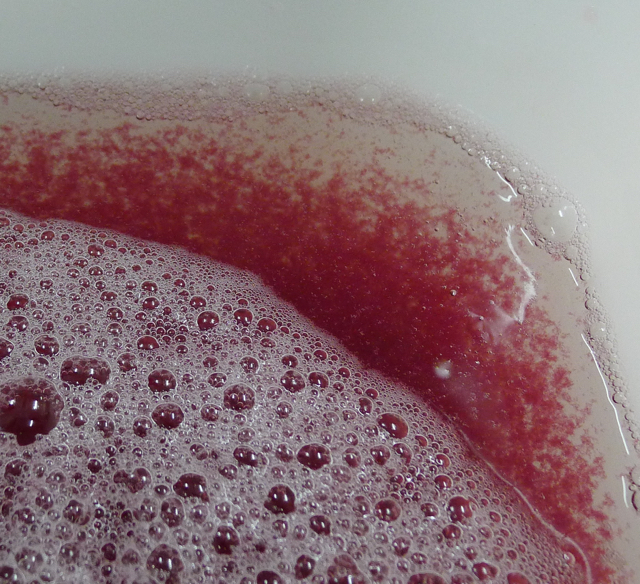
Potassium aluminum sulfate bonds with the dyestuff and makes an insoluble lake INSIDE the fiber. Without this insoluble bond, the dye can wash out. This is why we don’t put dye, alum, and fiber in the same pot; inevitably some of the dye will bind with the alum in the bath OUTSIDE the fiber. That would be a waste of our dye and mordant.
Version 2
Alum and dye in the same bath to make a lake. The dye has bonded with the alum and become an insoluble pigment.

The traditional  approach to mordanting and dyeing is broken down into two steps.  1.) The alum is applied to the fiber. 2.) The fiber is dyed in a second bath, attaching the dye to the mordant and making the lake inside the fiber.

It’s important to get the mordant INSIDE the fiber. That is why we pre-wet and heat wool so that the scales will open up and the mordant goes inside. Otherwise we have ring dyeing, with the mordant and dye just sitting on the surface.

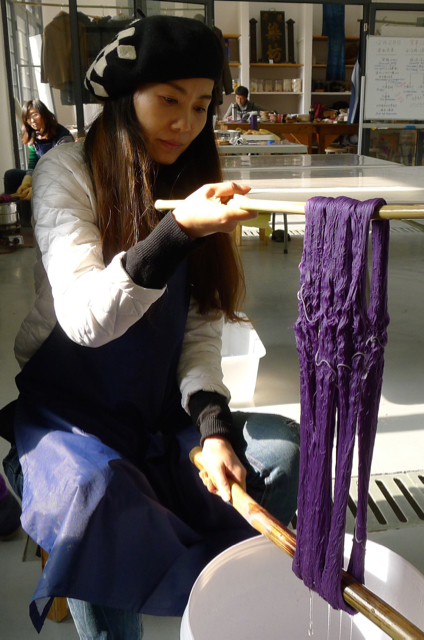
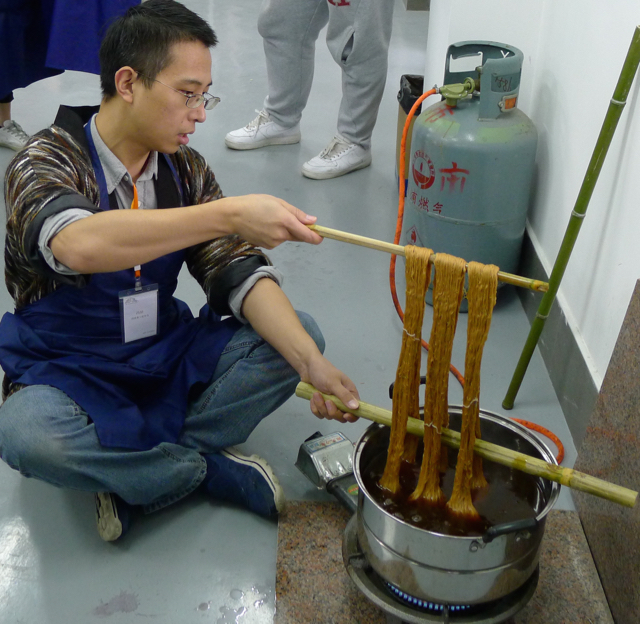
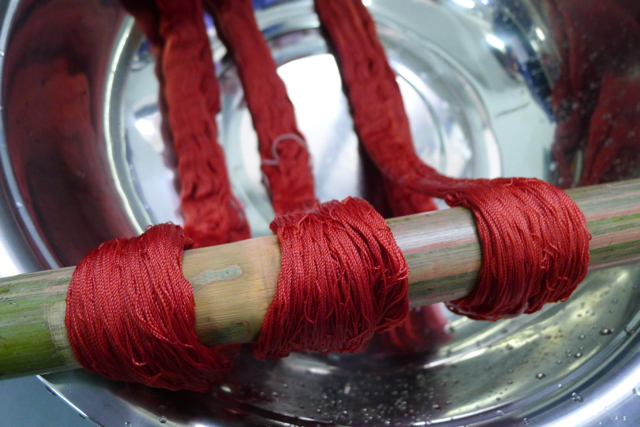
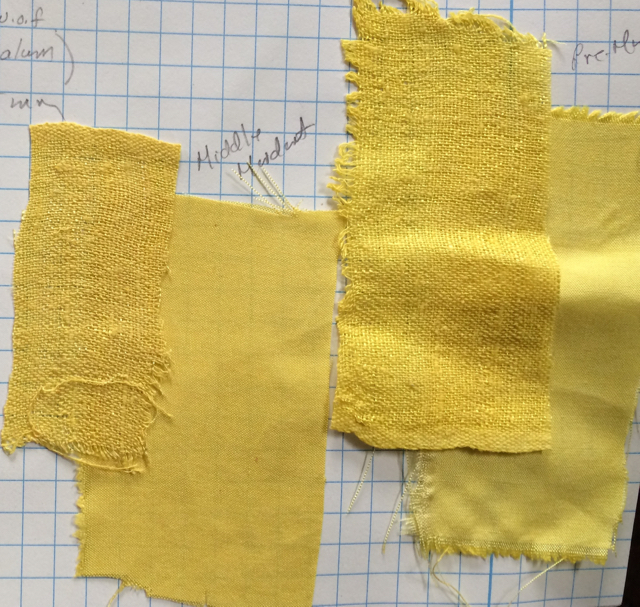
I have lately learned to dye silk using the Japanese approach of “middle mordanting” with Dr. Kazuki Yamazaki. The fiber is first dyed, then mordanted, and then re-immersed in the dye. This approach didn’t make a lot of sense to me until I experienced it and observed that it accomplished the same thing as pre-mordanting. The dye and mordant still go into the fiber and make the insoluble lake there. It’s a slower, quieter process which has the potential of building up layers of mordant and dye on the silk. This process is not suitable for wool.
P1070012
Sappanwood (Caesalpinia sappan) on silk: the first dyeing before the “middle mordanting”
P1070025
Sappanwood (Caesalpinia sappan) on silk yarn after the “middle mordanting” and subsequent dyeing

Some things to THINK about:

  • Alum is acidic – a useful thing to remember.
  • Once a fiber is mordanted, it is always mordanted. The mordanted fiber can be dried and stored indefinitely.
  • The more dye there is, the more mordant is needed.
  • Alum can be removed with a stronger acid, such as citric acid.
  • I typically use my alum at 15% of the fiber weight but I always test a new source of mordant in order to be sure that the strength is the same. Test by mordanting, dyeing, and observing.
  • Potassium aluminum sulfate is an excellent mordant for protein fibers.  I would take a different approach to mordanting cellulose.
  • When a dye lake is made OUTSIDE the fiber it results in an insoluble pigment.
  • When a dye lake is made INSIDE the fiber it results in an insoluble pigment.
  • How the mordant and dye are applied to the fiber is very important.
IMG_8355
Comparison of “middle mordant” and “pre-mordant” on silk. Weld (Reseda luteola) dye.

More thoughts on Natural Dye and Cultural Exchange in China…

Yoshiko I. Wada wrote the follow comment in response to the latest blog post. She was a very important part of this experience and I thought her words, with  additional insight,  deserved their own spot and thus the following:

“This is a friend of Catharine’s, Yoshiko I. Wada from slowfiberstudios.com and naturaldyeworkshop.com, where we re-blog Catharine’s blog in our Dye Nerds’ Blog. Since the person in charge of our blog is on vacation until the end January and I was g Japanese to English translator for Dr. Yamazaki I am jumping in for some additional thoughts and information.

The Jinze Art Centre in Shanghai and Slow Fiber Studios in Berkely, CA organized the workshops with Japanese masters working with my colleague Edith Cheung who is in charge of the textile program there.

P1070455
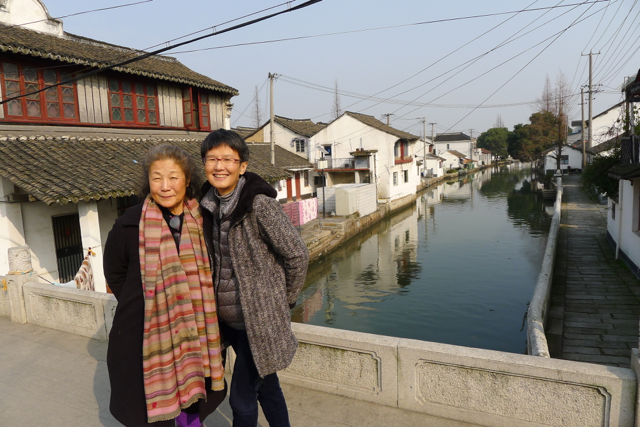
Yoshiko Wada and Edith Cheung in Jinze Town.

RE: Camellia ash (椿灰汁) since the Asuka Period (538 to 710 ) and Nara Period (AD 710 to 794) documents recorded that the Japanese dyers used the liquid strained from the camellia ash as a vehicle to shift pH and at the same time to access its alum as a mordant. Camellia is a plant which is called bio-accumulator of aluminum similar to symplocos, lycopodium and miconia. Those plants have been used as mordants in Southeast Asia, northern Europe, and Mexico respectively. The anthology of poems Man’yōshū 万葉集 literally means “Collection of Ten Thousand Leaves” contains many poems associating with purple colors (murasaki) and gromwell roots (shikon) and madder as well as camellia ash. The collection contains poems ranging from AD 347 (poems #85–89) through 759 (#4516), the bulk of them representing the period after AD 600.

image1
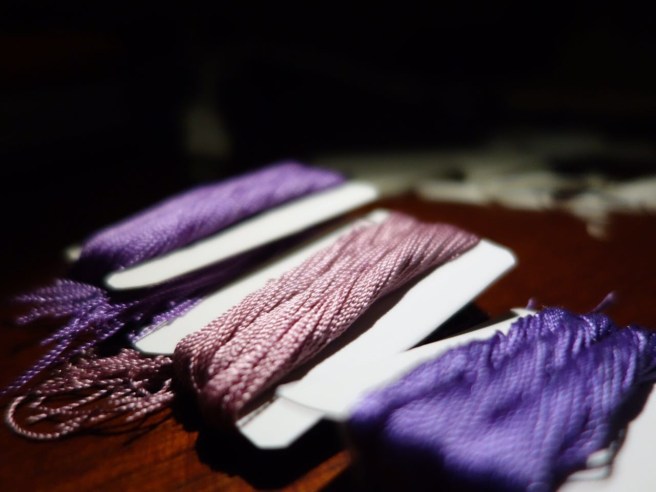
Gromwell on silk

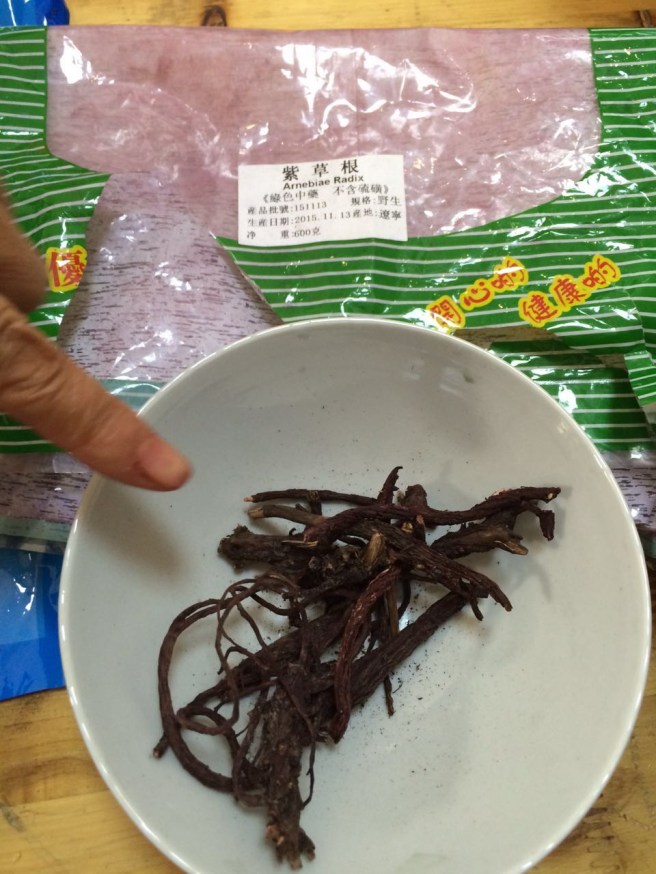
Catharine: At the bottom is the love poem by Princess Nukata I told you about. And it starts with madder (akane) as a pillow word but scene is the gromewll field (known to belong to Tenchi Emperor). Murasaki is purple and the plant was a precious medicinal herbs. From the poem, the guarded field may have hosted wild gromwell plants like the Super Gromwell Roots that Edith found in Hong Kong where herbalist told her “only the very best is found in Hong Kong.”

image3
Purple Gromwell roots (Arnebiae radix)

The wild purple roots were so strange looking compared to the ones imported from China that Dr. Yamazaki uses in Japan that it gave him such worries during the class. He thought after making the students knead the soaked roots for 2 hours on their knees on the floor, only grey pale purple is achieved.

On the contrary, we achieved the most beautiful purple even with limited time we had to process it all. Did he mention that in his studio, he kneads the roots a few times in the morning and some more in the afternoon to get maximum colorants from the plants? And he repeats dyeing, middle mordanting, and dyeing, many times in a few days to get saturated deep purple? He did say the purple dye extracted in this way has much more complexity and depth than the easy extraction with alcohol.

Yoshiko I. Wada

P1070308
Gromwell on silk with extraction by kneading and camellia ash mordant

茜さす紫野行き標野(しめの)行き野守(のもり)は見ずや君が袖振る 額田王(ぬかたのおおきみ).

訳)茜色を帯びる紫草が生い茂る(天智天皇の御料地である)野を行き,貴方は袖を振る.野守りが見とがめはしないでしょうか?

Dyeing Naturally and Cultural Exchange in China

I just returned from several weeks in China, where I did an artist residency at the Jinze Art Center near Shanghai. The residency was  focused on weaving and the study of Chinese local “tubu” cloth from the 1950’s and 60’s.

tubu
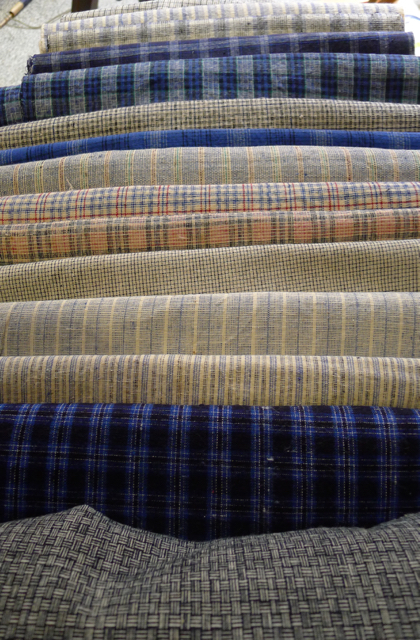
Cotton tubu fabrics

I also participated in a natural dye workshop with Japanese dye master, Dr. Kazuki  Yamazaki. Dr. Yamasaki is a 3rd generation natural dyer and his family has specialized in the traditional dye processes, which they have meticulously researched from the Japanese Heian Dynasty (about a thousand years ago). He is a well-respected practitioner, author and teacher.

tomoko silks
Dr. Tomoko Torimaru with silks dyed by Dr. Yamazaki

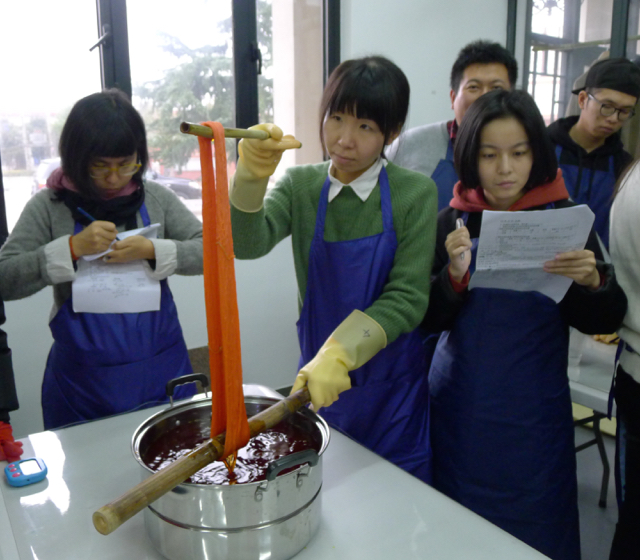
Each day we explored a different red dye on silk yarns and fabrics: Sappanwood (Caesalpinia sappan), Madder (Rubia Cordifolia), Lac (Laccifer lacca), Safflower (Carthamus tinctorius), and Purple Root/Gromwell (Lithospermum purpurocaeruleum). These are all special colors that would have been used by nobility (the commoners used mostly indigo and a lot of mousy browns). All of the dyestuffs we used were locally sourced in China.

Version 2
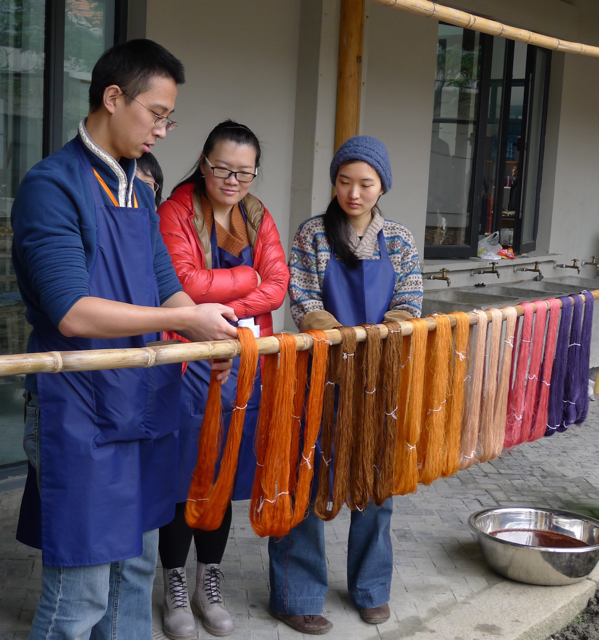
Silk yarns dyed with Sappan wood and Madder

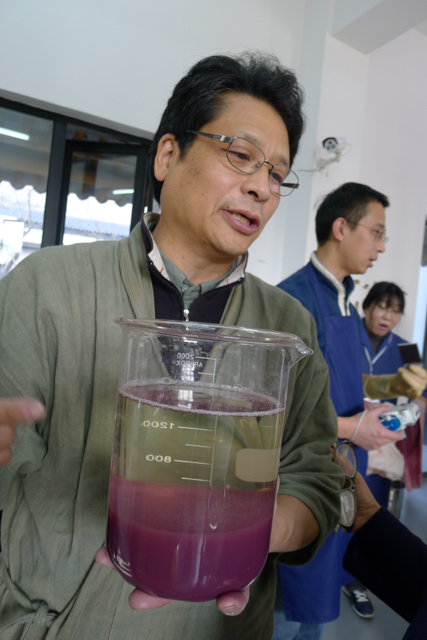
Although  our procedures every day were similar, each dye required special treatment. Dr. Yamazaki has a deep knowledge of botany and chemistry of the dye process so we learned “why” right along with the “how”. It’s rare to find this approach in the dye world.  For instance, the color is drawn out of each plant differently and by tweaking pH the hues can be made to shift dramatically. I very much appreciated his willingness to explain each step clearly.

yamazaki with safflower
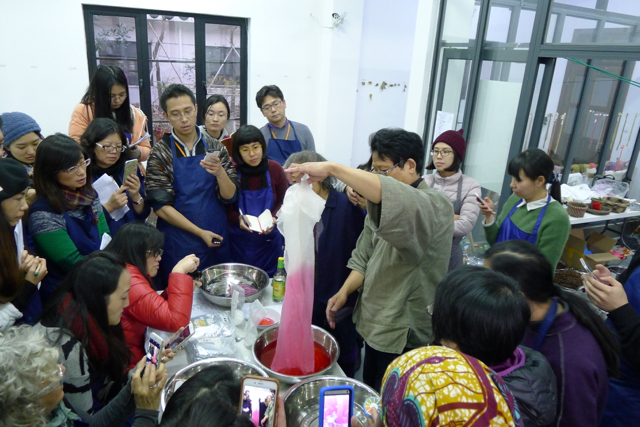
Dr. Yamazaki demonstrating one of the steps of safflower dyeing
ash
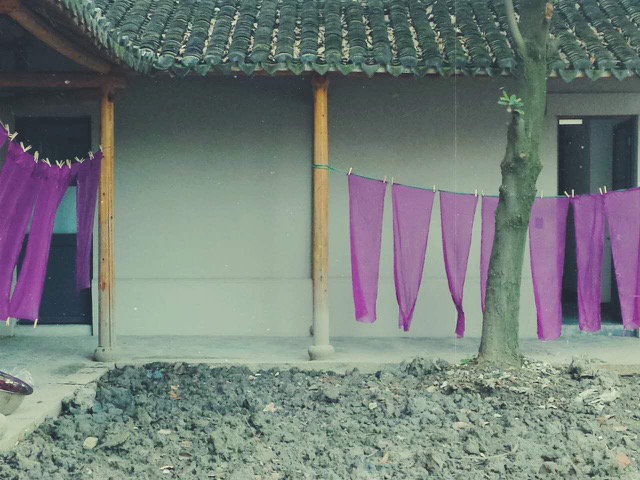
Camellia ash used as mordant and pH adjustor

Dyeing originated in China and spread to Japan many years ago but without the continued use of dye plants in Chinese medicine, there would be no dye industry to speak of in Japan. Most of the plants we used have medicinal properties in Chinese medicine. There was a young traditional Chinese doctor in the class who wanted to learn about the plants as a source of color, although she uses them regularly in her medical practice.

lac1
Silk dyed with lac

Our class comprised of

  • 1 Japanese teacher
  • 5 assistants
  • 2 translators (Japanese to Chinese, Japanese to English)
  • 3 Americans
  • 20 Chinese

So, as you can imagine it was quite a noisy classroom! Everything was written in Chinese characters, Japanese characters, and English. The Chinese and Japanese characters are similar but not always interpreted the same way.

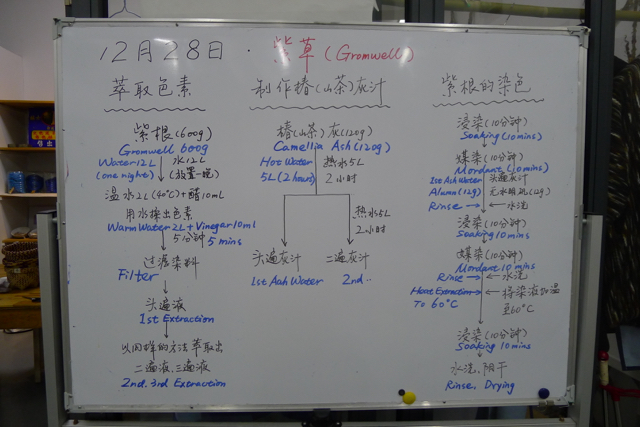
daily instruction board
The daily instruction board
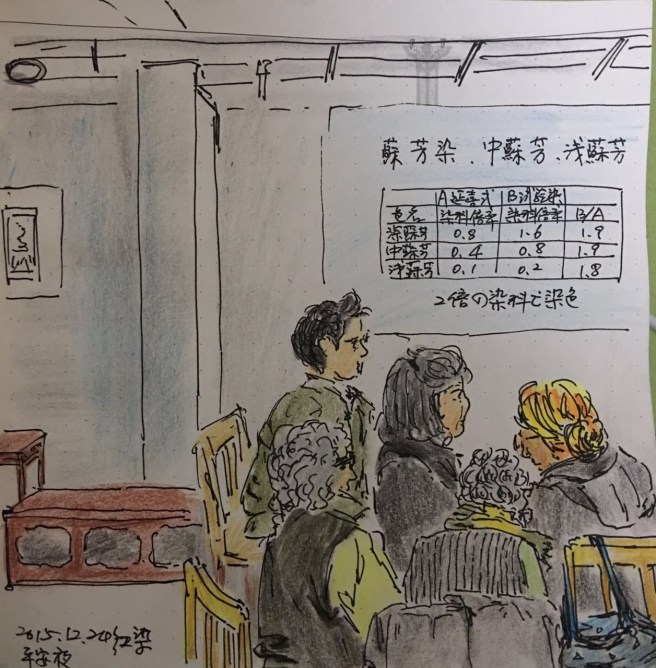
huddle
Japanese to English translation “huddle”. Sketch by workshop participant, Wang Dan

The 20 Chinese students were all young – in their 30’s or so. They were bright, inquisitive, and interested in their own traditions and history. It was a rich mixture of people and process.

skein dyein
Perfecting the process of dyeing silk skeins

In the west we typically use a European pre-mordant approach to dyeing: mordant first, then dye. But the Japanese approach to dyeing silks is quite different. The mordant comes in the middle: dye first, then mordant, and back to dye. The mordant and dye steps can be repeated many times to build up a greater depth of color. I have known about this approach for a long time but it never quite made sense to my western sensibility. I now see some genuine advantages to dyeing silks in this way and I’m anxious to explore this approach in my own studio dyeing.

There is always more to learn about plants, dyeing, chemistry, and process. Life and learning continues…

lake
Dr. Yamazaki with lake made from lac dye bath


IMG_8331
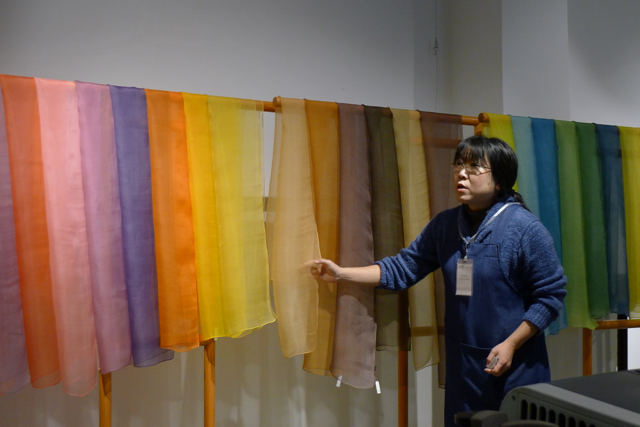
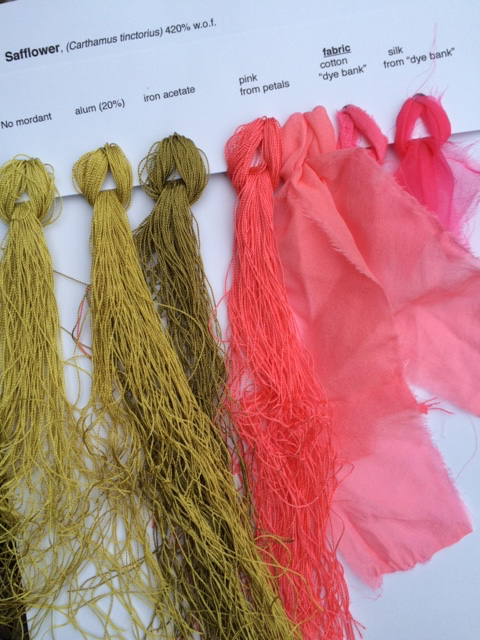
Colors obtained from safflower petals
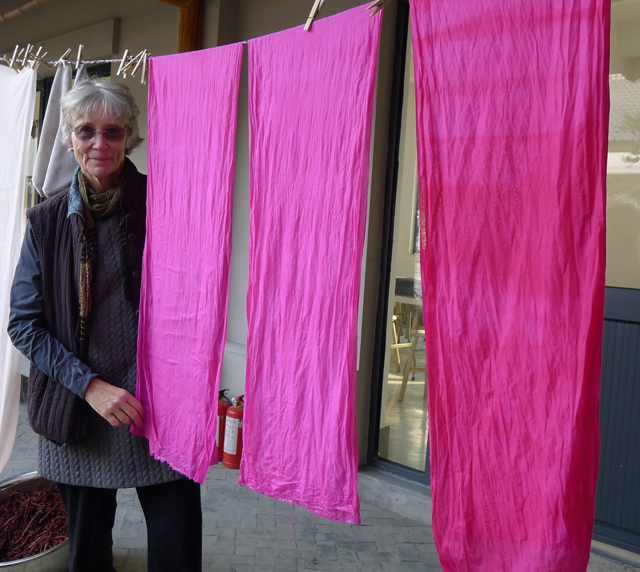
Safflower pink on cotton, ready to use for silk dyeing.
Safflower pink on cotton, ready to use for silk dyeing