Fermented Indigo Vat: Blog Post #13 –  A Wrap Up

© Catharine Ellis, as posted to the blog: Natural Dye: Experiments and Results

Over the last few weeks,  I have posted 12 “lessons” to help dyers who are interested in making their own fermented indigo vat. This is all based on my own experience from the last few years AND very importantly, the guidance I have received from others. These methods, procedures, and formulae have worked well for me over time. 

Now it’s up to you, dyers, to make your own vats, observations, and learn by doing. I do not have all the answers, nor do a consider myself an “expert” on fermented indigo vats and I am definitely NOT a dye or indigo chemist. But I am a dyer, who is curious, tenacious, and willing to try lots of things in the quest for learning and best practices for dyeing.

The world of indigo reduction, fermentation and dyeing is very complex.  There are so many decisions to make. Each dyer needs to think about and determine what works best for them. One of the comments made to the blog from Sophy Wong said: “root and rhubarb root.–Fructose powder: purified sugar.–Minerals: iron or zinc.–Microbes + fermented plants such as Tspecies in wheat/rice bran or sukumo indigo leaves.–Synthetic.” Yes,  Sophy, it’s a zesty mix of options!

So, please, share what you know and learn with others. We are a community of dyers. Although we may have different resources and varying opportunities, we are all searching for the best personal approaches to do our dyeing. It’s only through being generous with other dyers and sharing what we learn that our community will continue to flourish. This isn’t “goodbye” – this is “good dye!”.
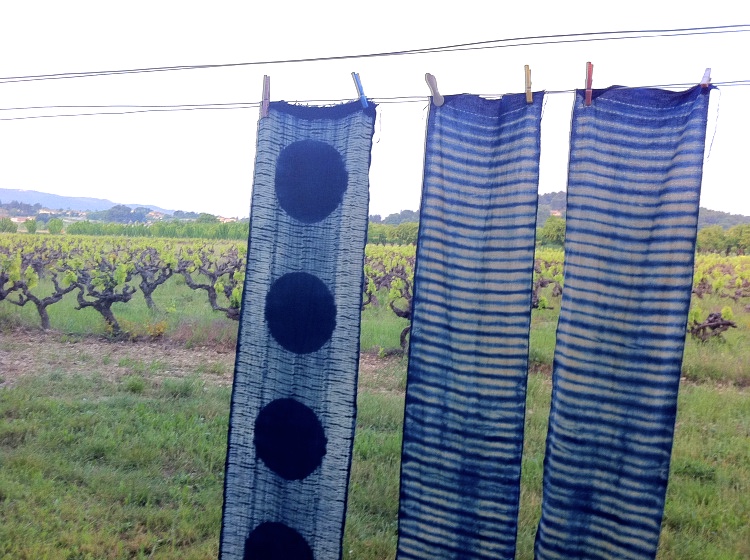
Early indigo dye work with woven shibori. Photographed in Lauris France by Elin Noble
Fermented Indigo Vat: Blog Post #12  Some further thoughts on the amount of indigo to be used in a fermented vat 

© Catharine Ellis, as posted to the blog: Natural Dye: Experiments and Results

When working with quick reduction indigo vats, it is quite easy to achieve pale colors using a weak vat by controlling the ratios. A fructose vat is made by using a certain amount of indigo per liter, and the other ingredients (fructose and lime) are proportional to the amount of indigo: 1 part indigo, two parts lime, 3 parts fructose. 

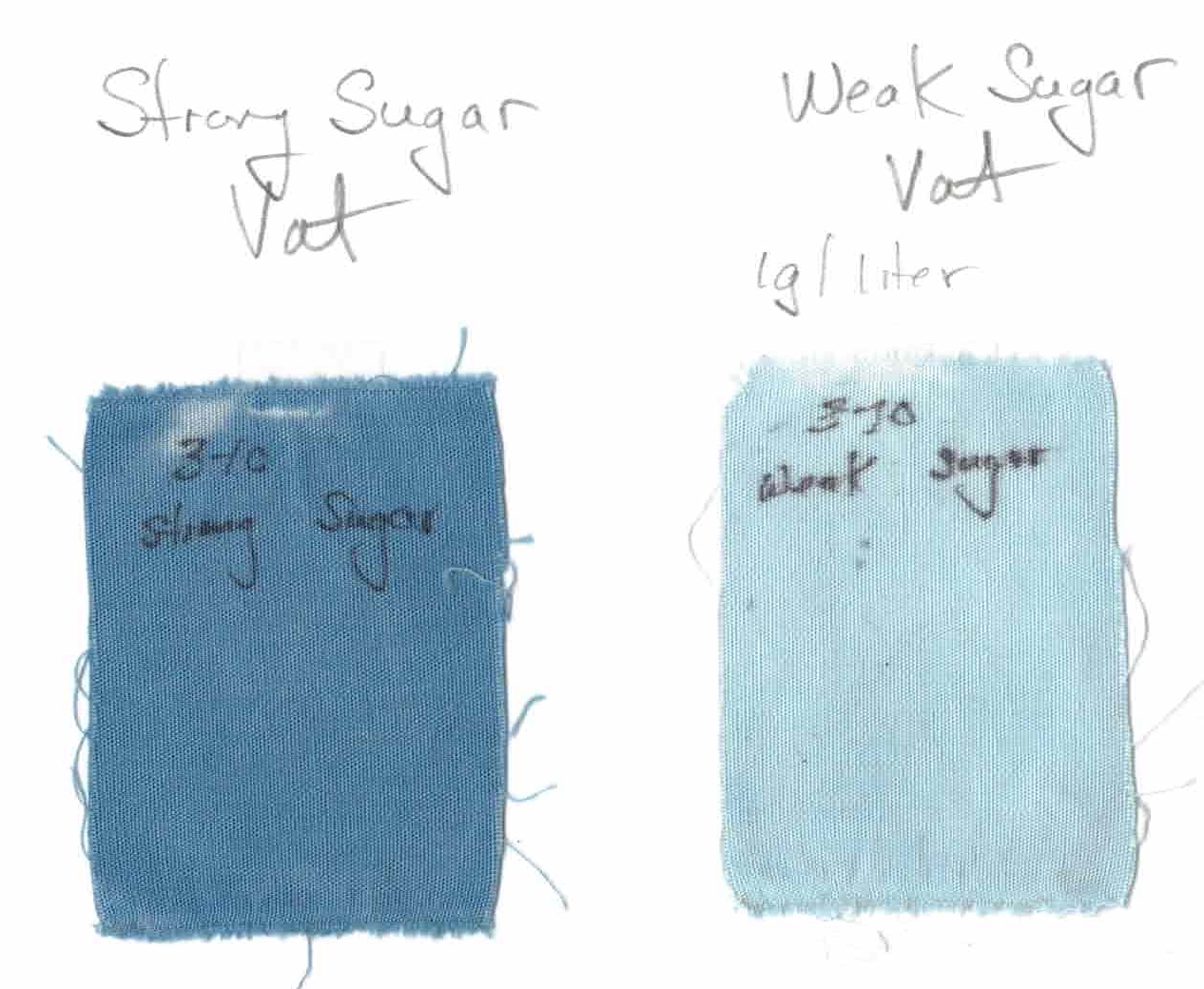
A fructose vat made with only 1 gram of indigo per liter will result in a much paler blue than a vat made with 8 grams of indigo per liter.  


Two fructose vats: The strong vat is made with 8 grams indigo per liter. The weak vat is made with 1 gram per liter

I have learned that the fermented vat does not work using that same logic, as was mentioned in Post #6. In order for the vat to work properly, there needs to be a certain amount of organic material to create adequatebacteria useful for fermentation.  The fermentation seems to be very efficient at reducing the indigo present in the vat. When I tried to make a “weak” fermented vat by using only 2 grams of indigo per liter, it did NOT result in pale colors. In fact, the shade of blue that it produced was almost identical to a vat that was made concurrently with 8 grams of indigo per liter.  The different concentrations of indigo in the two vats became obvious only over time. After several months of dyeing in each of the vats, the one with 2 grams/liter finally began dyeing pale blue shades. 

There is an additional reason why a weaker vat is valuable.  A vat that dyes a paler blue will invite long dips in the vat, and ultimately more “even” color.

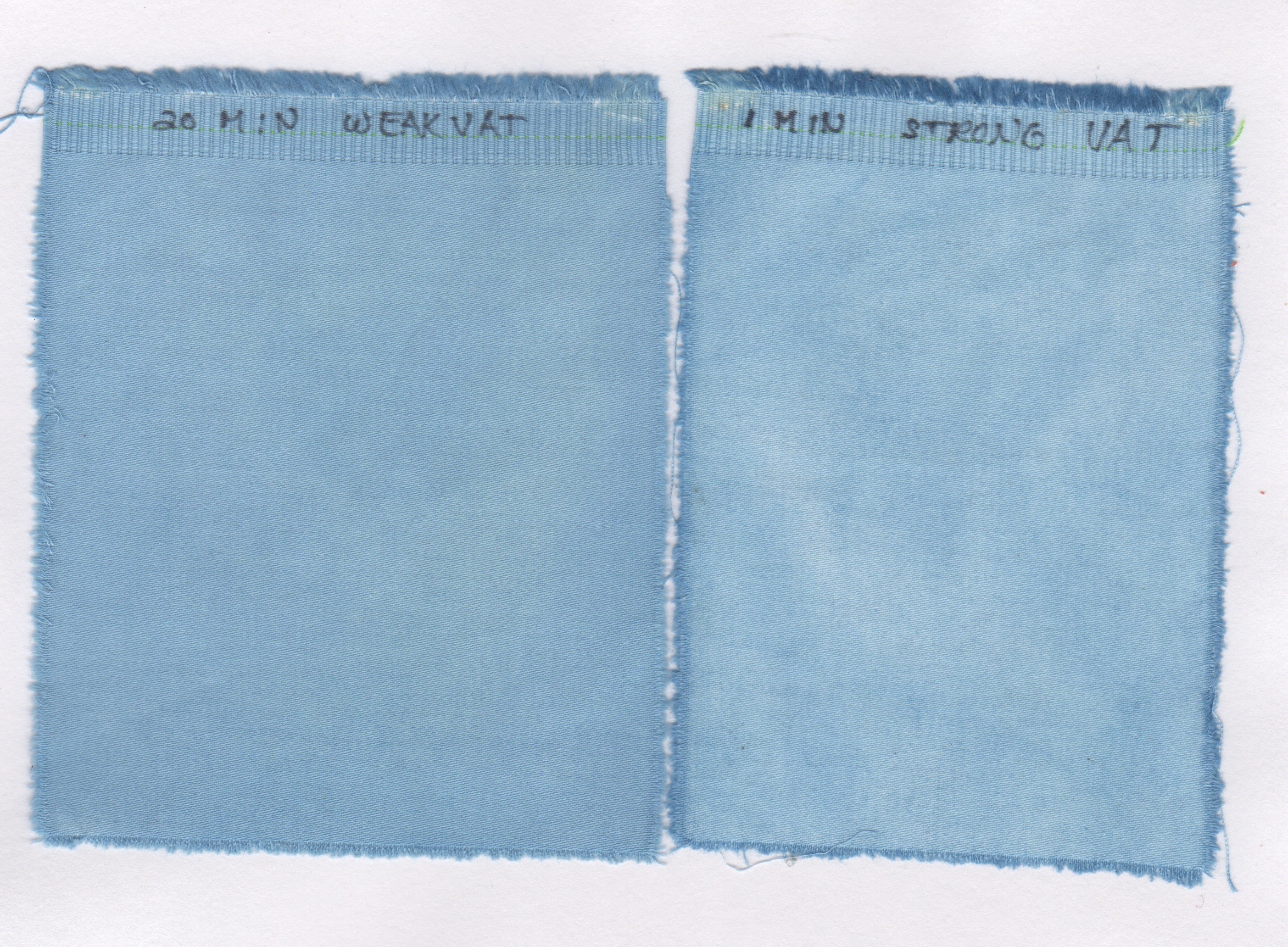
Both of these samples were dyed in fructose vats with a single dip. Sample on the left was dyed in a weak vat for 20 minutes. The dye has penetrated more deeply and is far more evenly dyed than the 1 minute dip in the strong vat.

I believe that the time required to deplete the amount of indigo in the vat is directly related to the amount of dyeing that is done, or how quickly the indigo is used up or exhausted. If I had been dyeing a larger quantity of textiles, the pale colors would likely have “come on” sooner. If at all possible, the dyer might want to keep track of the amount/weight of textiles that are being dyed. That may not always be feasible for the casual dyer but a production dyer could more easily track this information. 

The ability to dye pale shades of blue is important for any kind of color mixing. Think carefully about what you expect from your indigo vat when you establish it. 

Fermented Indigo Vat: Post #11   Problem solving and other practical stuff

© Catharine Ellis, as posted to the blog: Natural Dye: Experiments and Results

LOW PH

If the alkalinity of the vat falls too low, the vat becomes a good environment for water born insects. They may appear as small larva on the underside of the vat lid or at the “high tide line” of the dye vat vessel – just at the edge of the liquid volume. If the larvae are allowed to hatch, then small flying insects will appear at the surface. If this occurs, it is a clear indication that the pH has gotten too low and it’s important to rectify that immediately. Rinse off your lid to removed the larvae and wipe out the larvae from the sides. Then add lime, stir, and monitor the vat carefully.  Increasing the pH will create an environment in which these larvae cannot survive. The amount of lime required will depend on the size of the vat. Monitor the vat carefully for the next few days. 

Small larvae on the inside cover of my vat. This is a sure sign that the pH is too low and it’s time to add lime. If allowed to hatch, you will have small flying insects.

LARGE VATS

It’s best to place a vat of 50 liters (or more) onto a dolly with wheels so that it can be moved easily.

“SEEDING” OF VATS

Small test vats can be added to a brand new new vat in order to speed up the fermentation process.  I have successfully started 50 liter vat fermentation vats in less than 24 hours by adding 5 or 6 small test vats (fully reduced) in addition to all the other required materials for the larger vat.  This is an easy way to make a fermentation vat available for a workshop or class or  for building a vat more quickly in the studio. Think of it like a sour dough starter. 

CONTINUE TO EXPERIMENT

I often will mix up small test vats in order to learn, answer my questions,  and deepen my own knowledge:

  • Does soda ash work as well as potash? YES
  • Will spent Rhubarb root work as well as spent madder root? YES
  • Will spent Dock root work as well as madder root? YES
  • Will a fermented vat work with synthetic indigo? YES
  • Etc. etc. This is how we learn!