Experiments with Turkey Red

Turkey red is a process of dyeing cotton with madder. It uses oil to treat the textile before mordanting and dyeing to increase the brilliance of color and its ability to withstand washing. It was widely used in the 18th and 19th centuries.

A few years ago, Joy Boutrup and I did some quick tests together. We treated cotton with Turkey Red Oil. But the results were not good and so I abandoned it. Admittedly, I did not do further research at that time.

Following Maiwa’s online class, Natural Dyes: Alchemy Chemistry Craft, a small group of colleagues and I began a “study group”. Both the class and the study group have been a catalyst to delve a little deeper into some processes, including Turkey Red. Here are some of the results of my own testing and observations. This time I prepared myself better, did lots more reading and research and have been quite intrigued by the results.

 My starting point was Julie Wertz’s new book: Turkey Red (Bloomsbury, 2024). In this book Wertz does an excellent job of presenting its history, some chemistry, and the series of steps involved.

Turkey Red Dyeing is a process by which cottons were treated with oil prior to mordanting and dyeing (or printing) using madder. It was practiced regularly in the 18th and 19th centuries in Europe and, I believe, some in the US. The result is a brilliant red dye color that is very fast to washing. It was an important discovery in the textile industry, though its roots likely go back much further to madder dyeing in India where oils were commonly used centuries ago to treat cotton textiles. Oil is also used in Indonesia prior to mordanting and dyeing cottons with Morinda bark (Morinda citrifolia).

It is believed that the oil combines with the mordant and then with the dye, making a compound that is faster to washing and light. All the literature refers only to its use with madder red. To the best of my knowledge, no other dyes are ever mentioned relative to the oiling process.

Turkey Red Dyeing was usually done on unbleached, and non-mercerized cotton. These cottons do not have an affinity with mordants and thus are more difficult to dye with deep, saturated red colors.

Jim Liles, in the Art and Craft of Natural Dyeing discusses the Turkey Red process in some detail and includes recipes. My other resources include old industrial dye manuals* from the early 20th century. These are the same manuals that Joy and I used to develop some of the recipes in The Art and Science of Natural Dyes.

The Process: Un-mercerized cotton yarn was scoured thoroughly and allowed to dry. The dry yarn was then immersed in a 50% solution of Turkey Red Oil and water, then dried again. Multiple oil treatments are recommended, drying in between each. I oiled and dried the yarn up to 3x.

All samples were dyed using ground madder root @ 50% weight of dry fiber. I did not use oil in the dye bath or as an after treatment, as some recipes recommend.
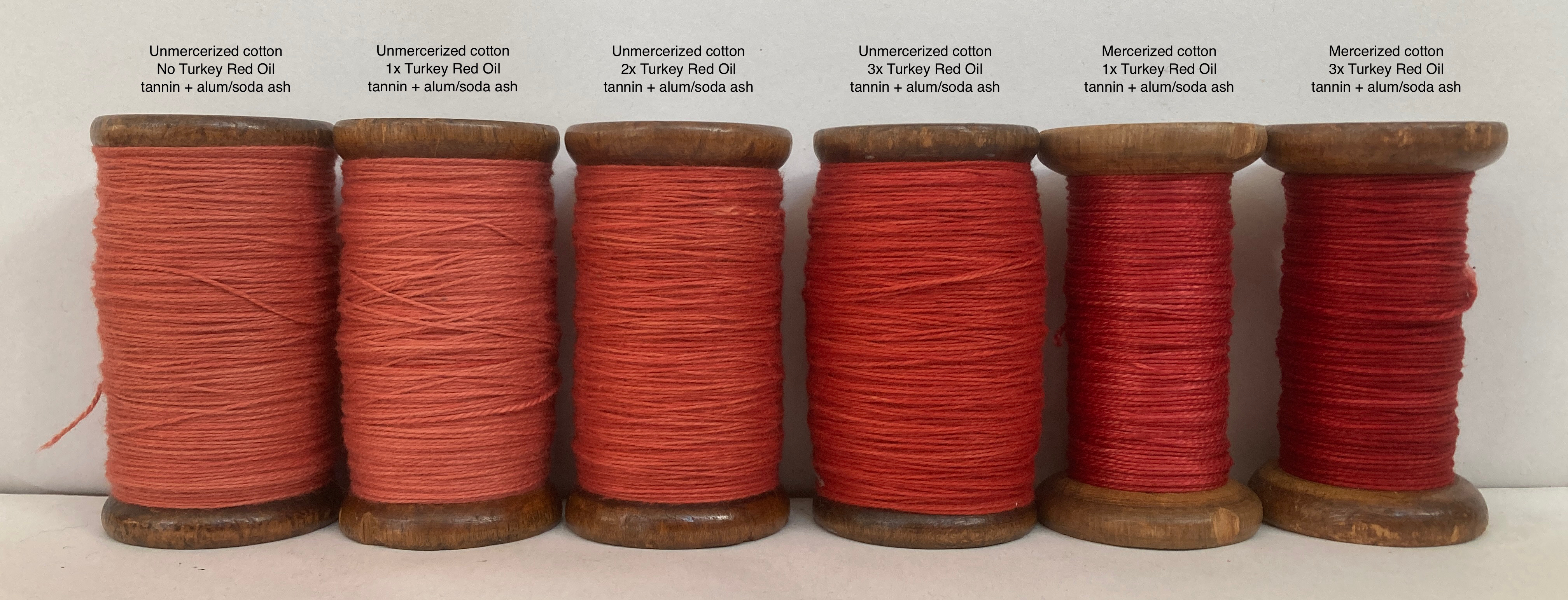
My initial tests do indicate the effectiveness of the oil treatment. A deeper red color results after the treatment with oil. A single oil immersion resulted in a slightly deeper shade of red, but three oil immersions in the oil (drying in between each) resulted in a much deeper color. What would happen if it was oiled 4-6 times – which is recommended?

Oil applied to mercerized cotton yarn also illustrated the effectiveness of the treatment. Mercerized cotton always takes up mordant and dye more readily without any additional treatment. Clearly, the oiling did increase the dye take up even more.

An interesting fact: John Mercer, who invented the mercerization process in 1844, also has his name on the patent for Turkey Red Oil. Mercerized cotton always dyes more easily and results in deeper colors with any type of dyeing.  Perhaps, when mercerization became common, the need for the labor intense process of oiling was no longer necessary or financially viable.

Follow-up question: All references to Turkey red dyeing use madder as the dye.  Is there a bond made only between the oil and the mordant? Would oiling of the textile prior to mordanting and dyeing with weld or another dye also result in a deeper color?
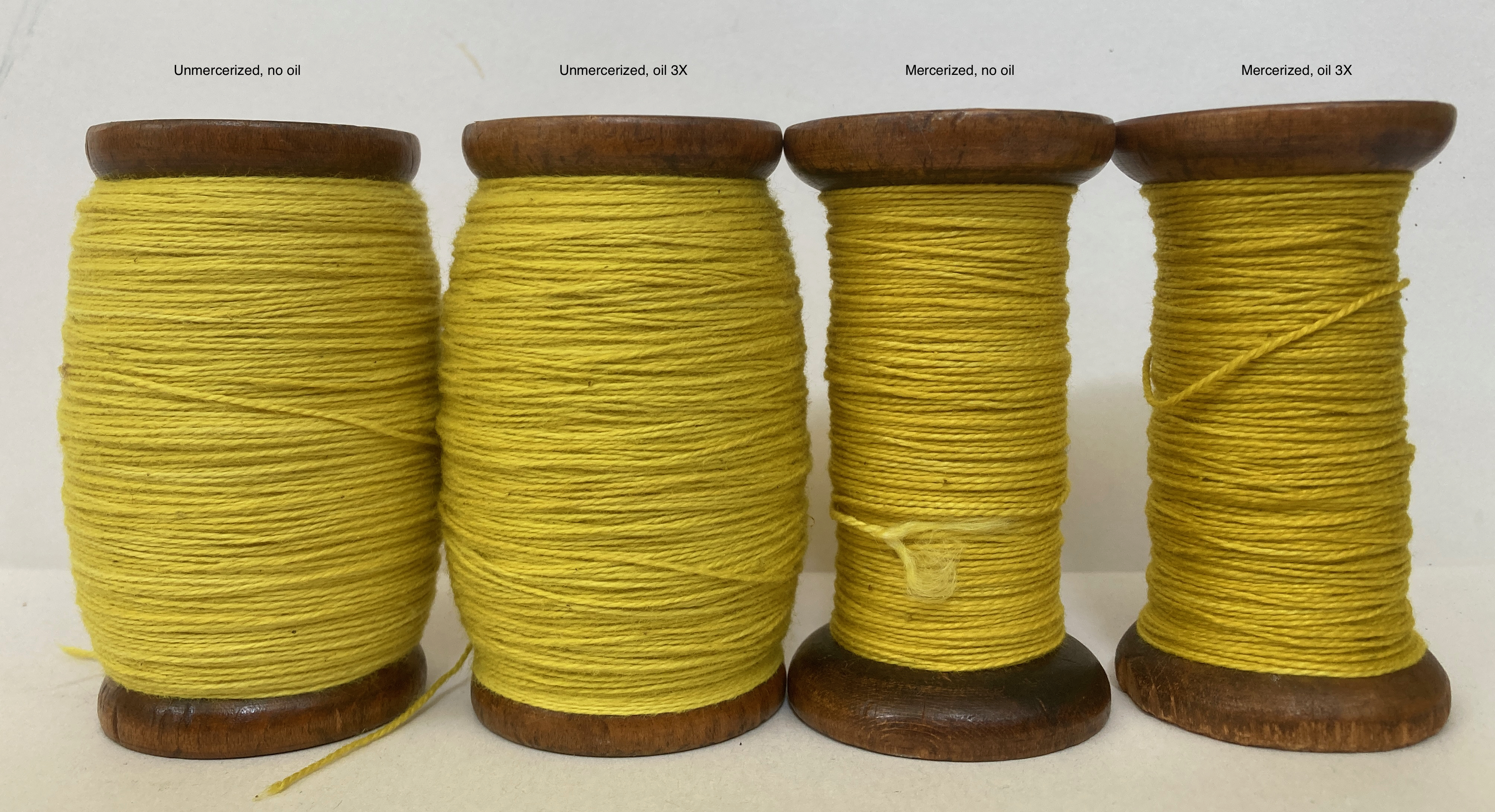
Initial testing indicates that the oiling of cotton prior to dyeing with weld results in a slightly deeper color but it isn’t nearly as dramatic as the madder dyed textiles.

After completing lightfast tests with both dyes, I observed a subtle difference in the way they reacted to light, taking into consideration the relative “before” and “after” of each dyed yarn following 3 weeks of exposure to direct sun.
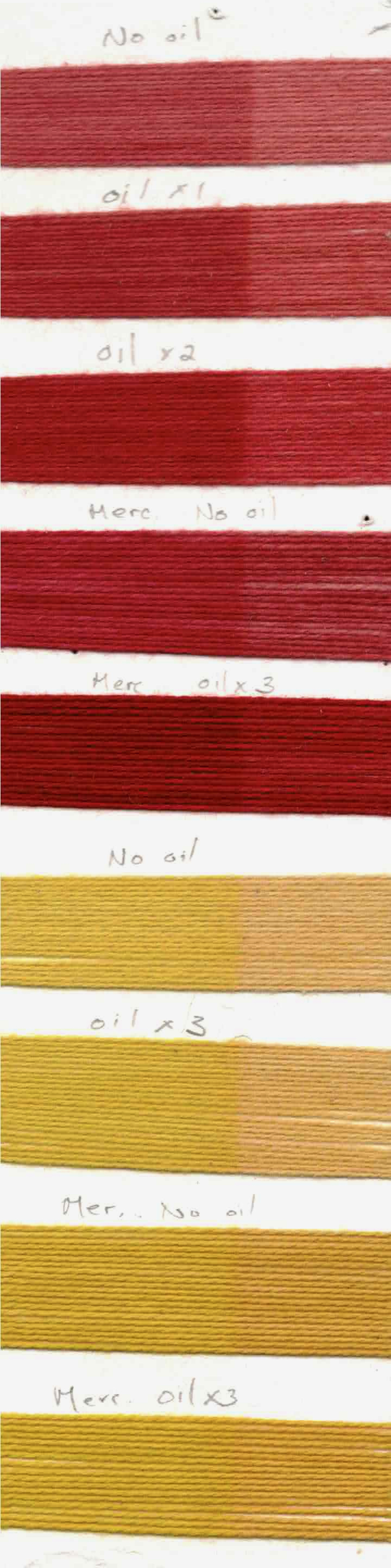
Wash fast tests, on the other hand, were much more dramatic. I used yarns that had been dyed both with and without the turkey red oil treatment. The yarns were then woven into a cloth with a dark grey warp. After only 10 regular wash cycles in my machine (along with the rest of my laundry), I observed a significant difference in the color loss of the dyed yarns with both the madder and the weld.
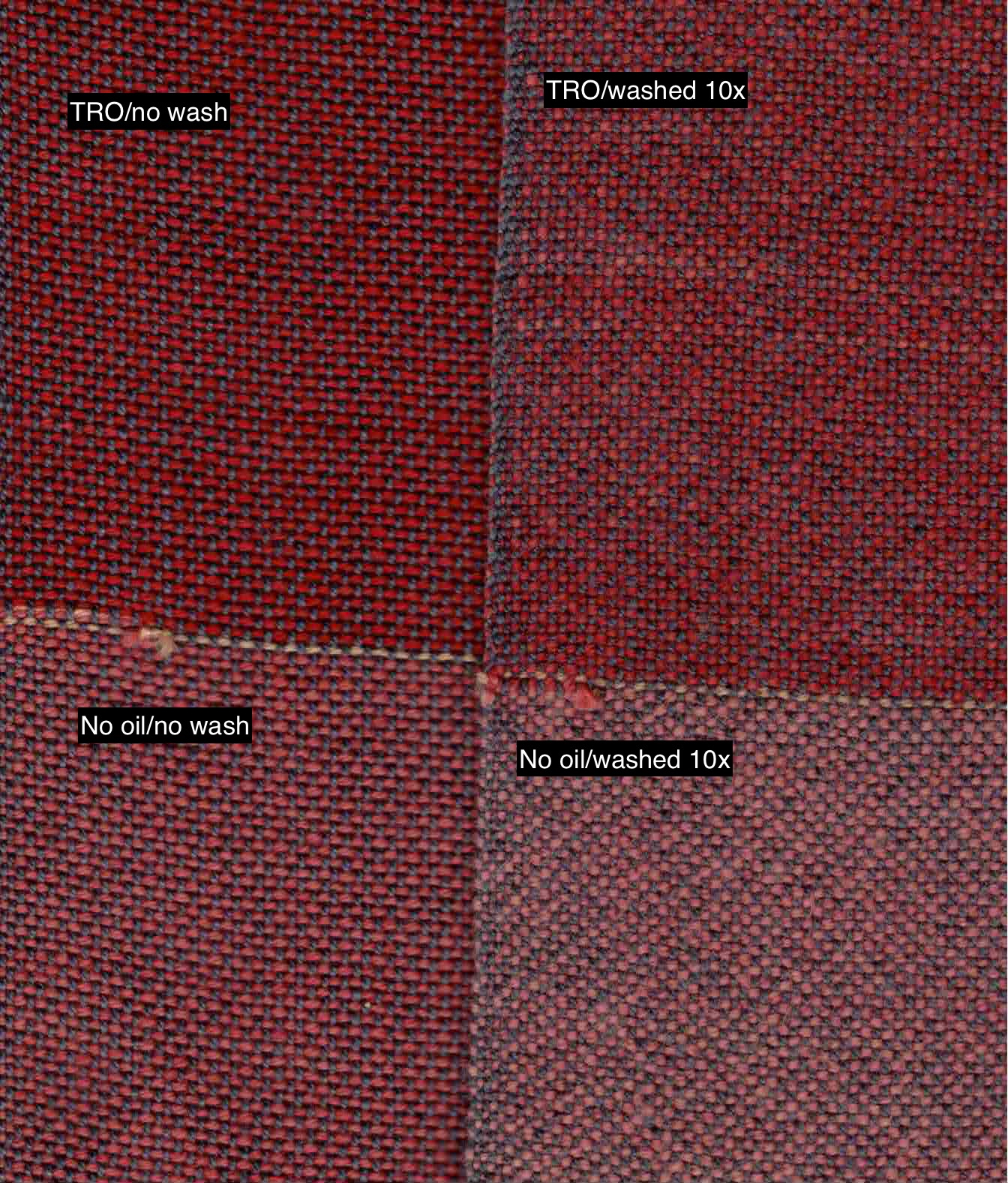
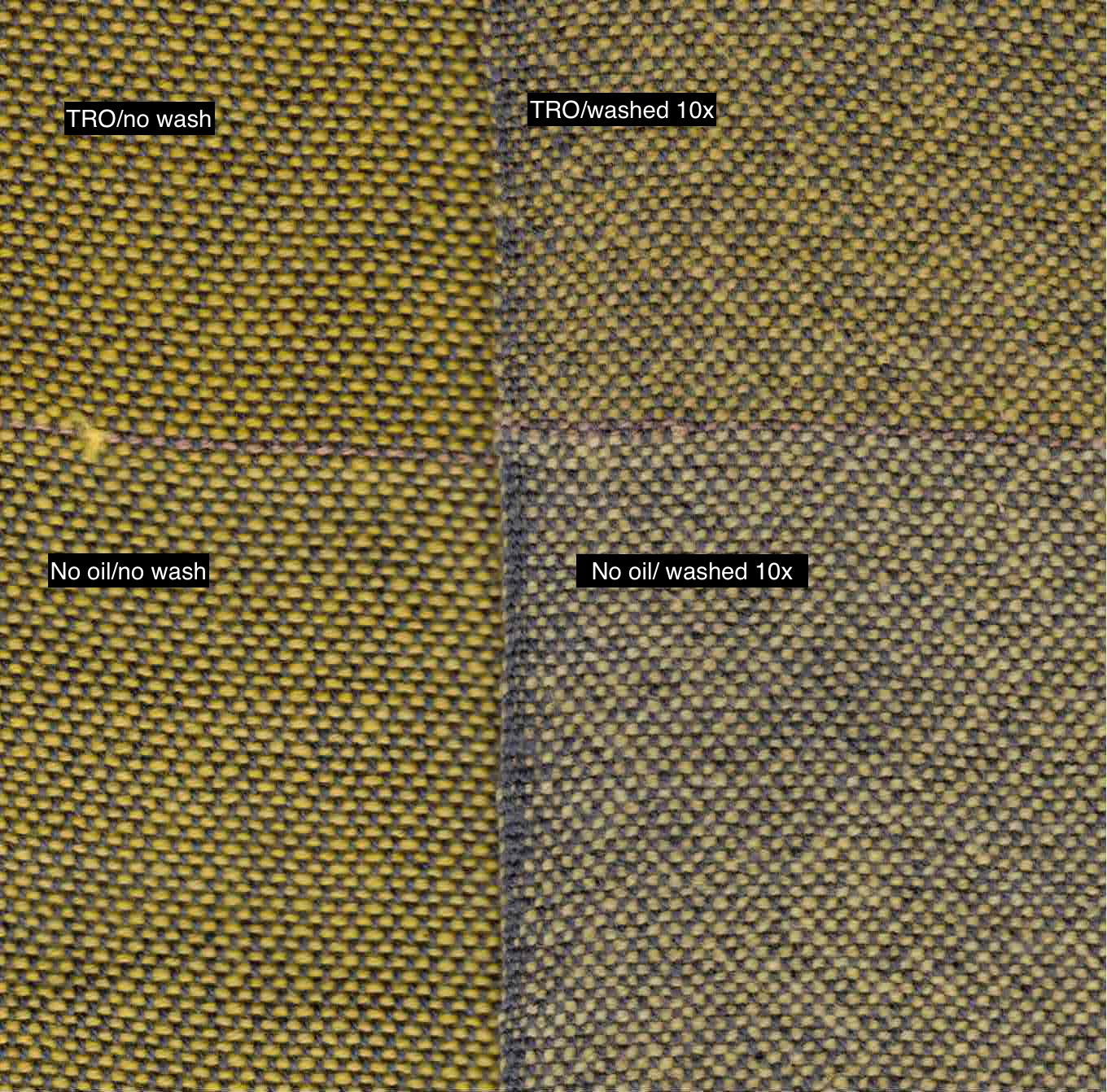
Once again, I am humbled by the research of dyers who came before us. I will seriously consider using the oil treatment when making textiles that could be laundered frequently.

*General Dyestuff Corporation, Manual for the Dyeing of Cotton and Other Vegetable Fibers (1936)

Kneckt, Rawson, Lowenthal – Manual of Dyeing, Volumes 1 & 2 (1893)

Madder for the Indigo Vat

It is exciting to see such a passion for indigo these days, and especially the active exploration that is happening. With this also comes with a deeper understanding of indigo dyeing and process. 

Vats reduced with chemicals such as sodium hydrosulfite or thiourea dioxide used to be the norm when I first learned indigo dyeing in the 1970’s. But now, many dyers have abandoned those chemical reduction vats and are returning to more benign processes. They are now making quick-reduction vats that are reduced with sugar, fruit, plants, or iron – thanks to the teaching of Michel Garcia. Some are growing their own indigo to explore fresh leaf dyeing and pigment extraction. Others are making sukumo – a long process of composting persicaria tinctoria leaves – Thank you Debbie Ketchum Jirik for offering an online class this past fall. Recently, Stoney Creek Colors has introduced a natural, pre-reduced indigo. And more dyers than ever are now exploring vats that are reduced by fermentation.

Fermentation is the process that has captured my interest in recent years. The long-term committment seems to fit my own “stay at home” life right now. The lower pH is suitable for all fibers. Most of all, it’s been an interesting adventure. Something that once felt out-of-reach has now become my preferred process. 

The fermentation vat utilizes plant material to initiate and maintain an alkaline fermenting process, which causes the indigo to become soluble. During fermentation, plant material is broken down, creating bacteria. Lactic acid is produced, making it necessary to monitor the pH on a regular basis. 

Madder root is a common plant material used in a fermentation vat. There is a long history of its use in indigo vats. It is usually combined with wheat bran, which ferments readily. There are many recipes in old manuals for this Madder Vat.

From The Dyer’s Companion by Elijah Bemis (originally published in 1815, Dover Edition, 1973)

for a vat of 12 barrels (not sure what a “barrel” is)

  • 8 lbs potash
  • 5 lbs madder
  • 4 quarts wheat bran
  • 5 lbs indigo

When I first leaned of these vats made with madder, I struggled with the idea of using perfectly good madder root to reduce an indigo vat. But I have now come to understand that these vats were most likely made with “spent” or “used” madder. I remember Michel Garcia talking about how the “used” madder from professional dye studios in the past was sold to the indigo dyers after it had been used to produce red dye. Indigo dyers have no need for madder’s red colorants and thus nothing was wasted. 

So, I am dismayed each time I hear from someone who has made a fermented indigo vat using “new madder root”. “Spent” or “used” madder is every bit as effective as a fermentation booster as fresh or “unused” madder. 

Most of the madder I use in the studio is in the form of finely ground roots, though chopped roots would work as well. When my madder dyebath is finished, I strain the ground roots and dry them for later use in an indigo vat. It’s that simple! And nothing is wasted. 

Equal amounts, by weight, of “used” madder root on the left, and “new” madder root on the right. Most of the colorants have been removed from the madder in the dyeing process, leaving only the starches and sugars of the roots.

Plant materials, other than madder,  can be used in the fermentation vats. I frequently use dried indigofera leaves, as well as woad balls and have even begun a “hybrid “ vat using sukumo with indigo pigment. My most recent experiments have used both Dock root and Rhubarb root successfully. Madder, Dock and Rhubarb are all roots, all anthraquinones…..

Madder Roots, Harvest, and Comparisons

For  a number of  years I have been using  madder (Rubia cordifolia) sourced from Maiwa (in Vancouver, BC almost exclusively for my dyeing. I particularly appreciate  the fact that it is finely ground so that I am usually able to just put the dye into the bath along with my textile. If dyeing yarn, however, I typically will  place the ground dye into a net bag  to keep small particles of madder from physically attaching to  the fibers.  

I once heard Michel Garcia speak about the fact that you can nearly double the yield from madder root if it is finely ground. It makes sense. More surface area means that it’s easier to extract the dye. 

Early last year I harvested about 5 pounds of madder roots (Rubia tinctorium) from my garden. The plants were started  from seed and they had been in the ground for about 5 years. I dug up the entire bed (about 4’ x 8’), pulled up the largest of the roots, leaving the smaller roots in place. I amended the soil, added some chalk, and the plants have continued to grow in the same location. My theory is that I can continue to harvest every few years by  leaving the roots in the same place and repeating the amendment process  We’ll see…

I cleaned and dried the roots. Some of the dyes are developed by in the drying process so that is important.  A few weeks later, I dug up another small patch.  With this second batch, it occurred to me that maybe I could grind up the roots before drying them. It was easy to chop up the fresh roots into small pieces with an old food processor that I have designated for studio use. Once chopped, the roots dried very easily on horizontal screens.

Last month, I was preparing a major piece for an exhibition and I wanted to use my own madder. The large, dried roots proved to be problematic. I wanted to grind them as fine as possible but was not sure how to proceed. 

I tried a mechanical corn grinder. It was a terrible experience! The grind was very coarse, the roots jammed in the grinder, and it was not at all successful. I tried the old food processor – not powerful enough to be effective.  I even tried grinding small amounts in a dye-designated coffee/spice grinder. It was better, but still not very good and it would have taken far too long since the capacity of the grinder was very small. 

I did some research, and finally decided to purchase  a powerful electric grinder that is recommended for medicinal herbs (roots) etc. It was amazing! First, I quickly broke the roots into smaller pieces by hand, which allowed me to pull out the “chaff” (the stem pieces with no dye). I put the smaller root pieces into the grinder and I had finely ground madder root in just two minutes!

I’ve learned a lot (of course). Madder root, even when dried completely, still has elements (sugars maybe?) that coated the bowl of the grinder with a layer of sticky madder. The bowl of the new grinder cannot be immersed in water so I had to work hard to clean it out. But the madder is all ground and the grinder is  now ready to grind my dried sumac leaves and some other tannins. 

In our book,  The Art and Science of Natural Dyes, Joy and I discuss and show examples of how a dyer sometimes has more control over the color when using madder roots rather than extracts.  The source (and type) of the roots is also a factor.  Madder contains many different dyes and the two different species contain different combinations. 

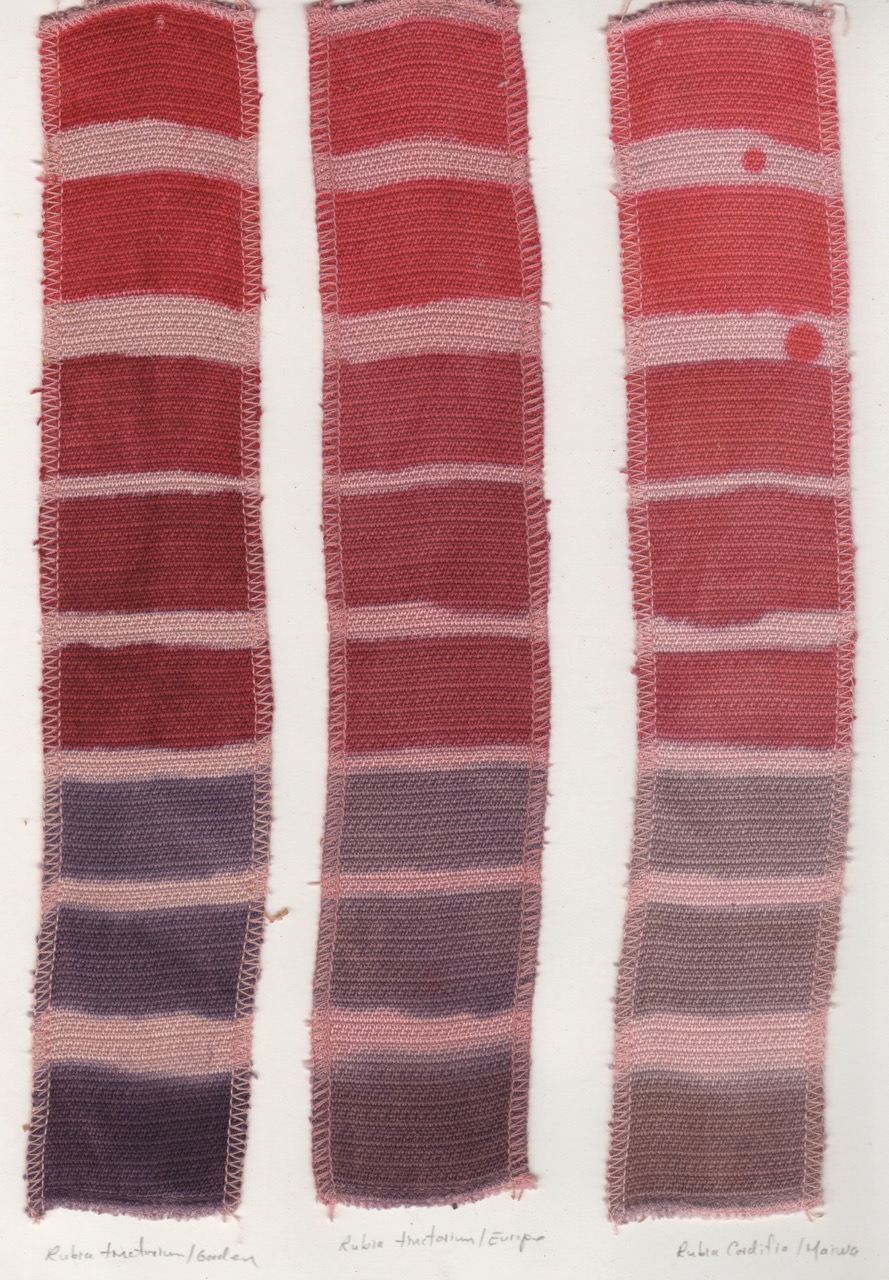
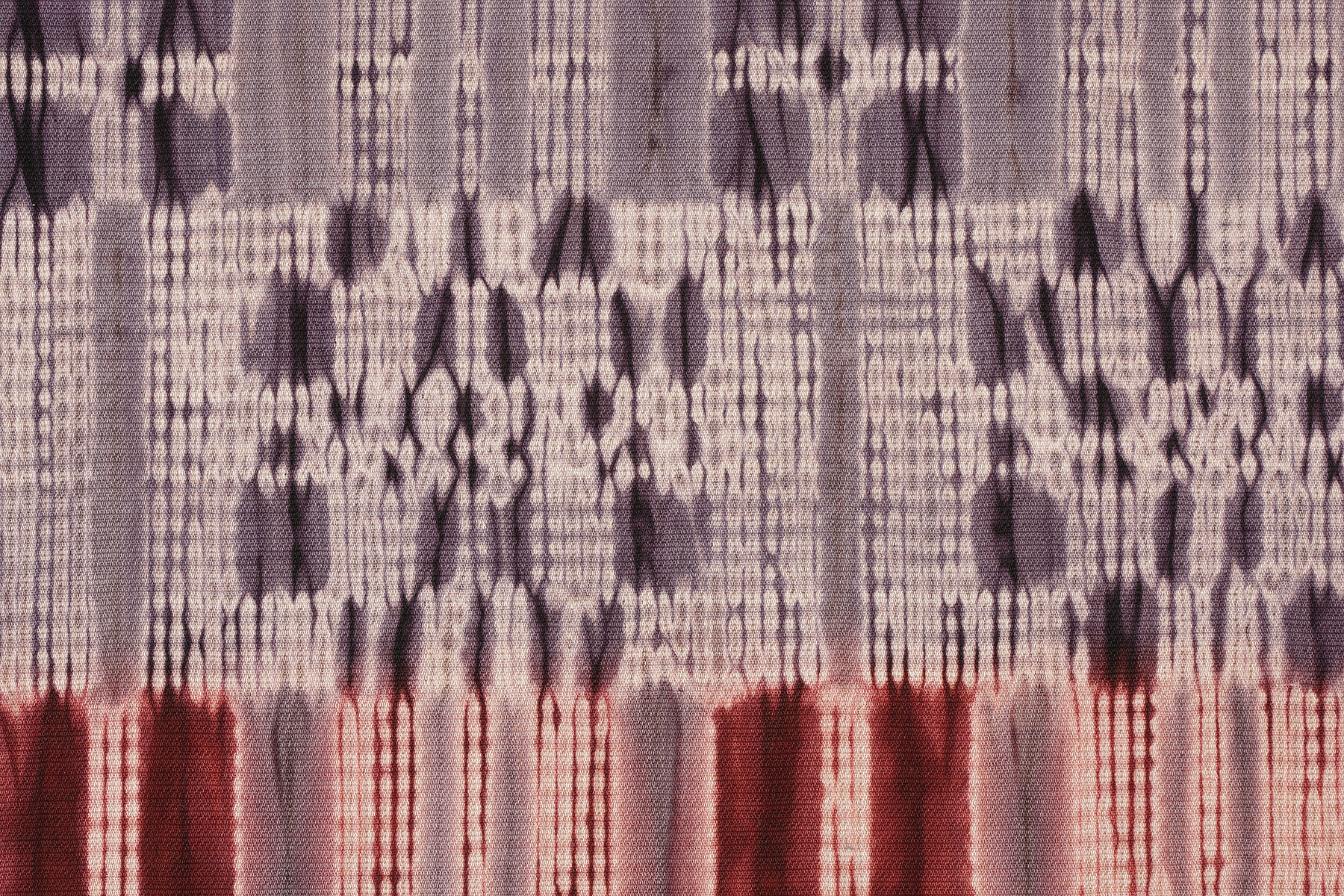
As  I began my tests for the exhibition piece, I did many samples and used madder roots from a variety of sources.  The woven shibori project utilized mordant printing with different strengths of aluminum acetate, ferrous acetate, and combinations of the two mordants. When Rubia tinctorium is used with iron mordants, it is possible to achieve distinct purple colors. The purples are not possible with Rubia cordifolia, as the dyes within the roots are different. I was very happy to observe that my own madder was the very best of all!

madder comparison cotton
Ground madder root @ 50% w.o.f. on cotton with mordant printing. Left to right: Rubia tinctorium from my garden, Rubia tinctorium from France, Rubia cordifolia from India (Maiwa). Note the purples achieved from the Rubia tinctorium with an iron mordant.


Garden Series: Madder, detail of finished piece

I am very encouraged to keep growing…and dyeing….

I have begun using my own copy of The Art and Science of Natural Dyes in the studio and in my teaching. No, I do not have all of those recipes committed to memory! I have found it very useful to add tabs to the book, making it easy to navigate and find exactly what I’m looking for.

book

Note: Maiwa now carries very finely ground Rubia tinctorium roots.


Digging Deeper into a Single Dye – Madder (Rubia cordifolia)

I’ve been using a lot of madder. I have madder roots from my own garden and extracts on the shelf,  but right now I’m focused on the fabulous ground Rubia cordifolia from India that I purchased from Maiwa. It’s ground very, very fine. Charllotte tells me that it’s ground on a mill stone.

P1080247
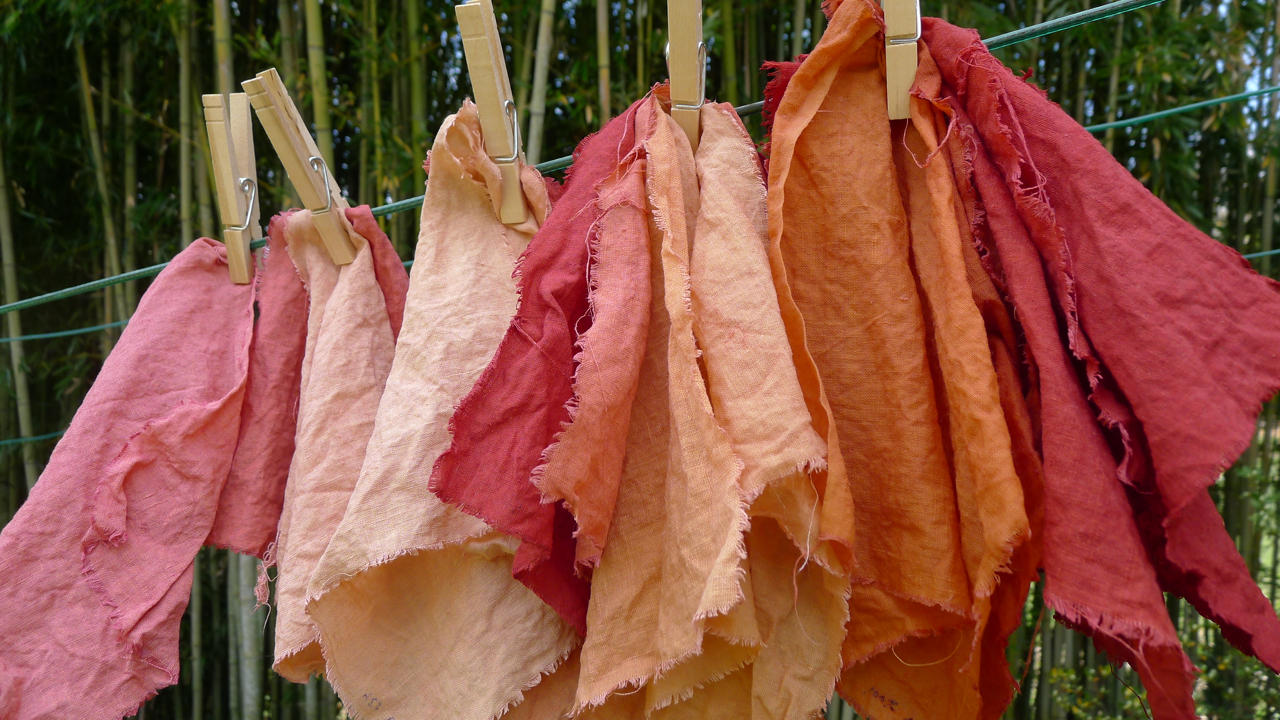
Madder (Rubia cordifolia) on linen

Because the particles are so small, the dye is extracted more easily than from chopped madder root. The color is redder than I would expect from a rubia cordifolia. I love it!

Once the fibers are mordanted correctly I’ve usually been content to make a full strength dye bath. There is always leftover dye in the bath, which most often  gets turned into a dye lake. I didn’t have a full understanding of how much dye was actually in the dye pot or what  remained after the initial dyeing. In order to control my colors and  mix them effectively I needed a clearer picture of dye strength and hue.

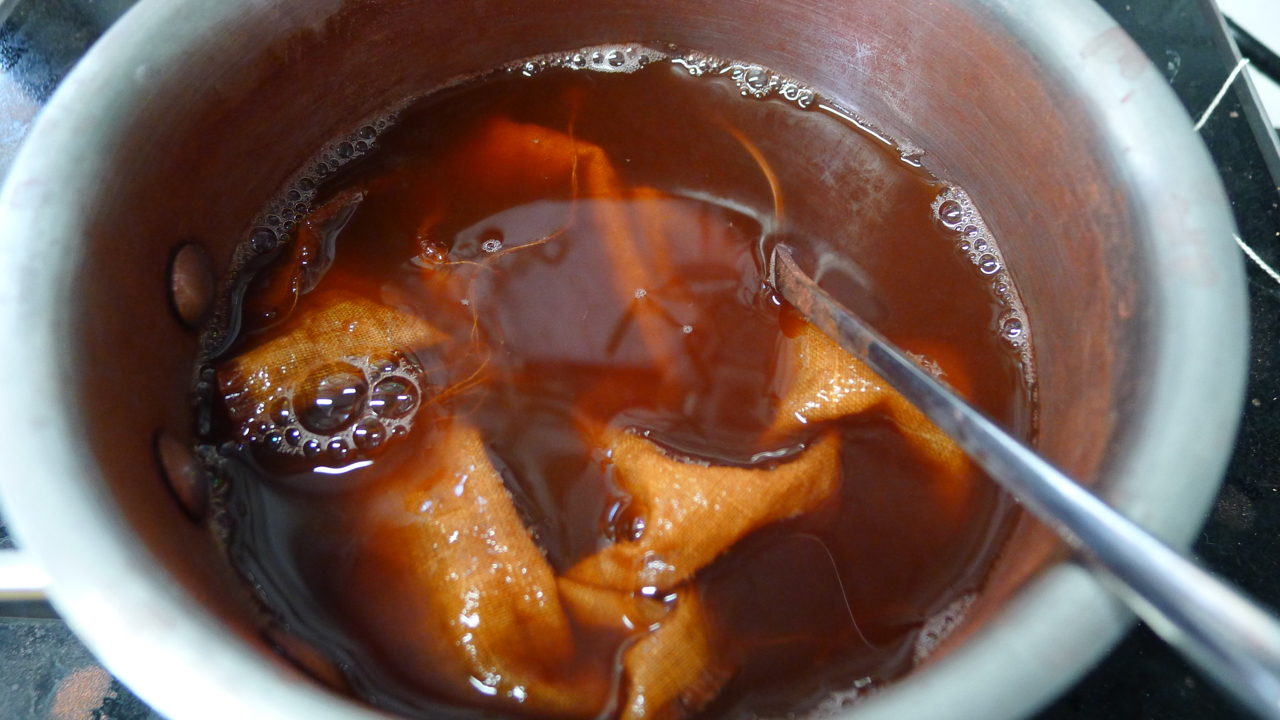
I embarked on a systematic observation of the dye. The fiber was linen. It was treated with tannin and mordanted with aluminum acetate. I weighed out the total amount of dye that was needed for my various samples.  Typically I do 2-3 extractions in order to make my dye bath but this time I decided to continue extracting until there appeared to be no more color coming from the ground root. This took SIX 20 minute extractions! I realized that I had previously been wasting some of the dye.

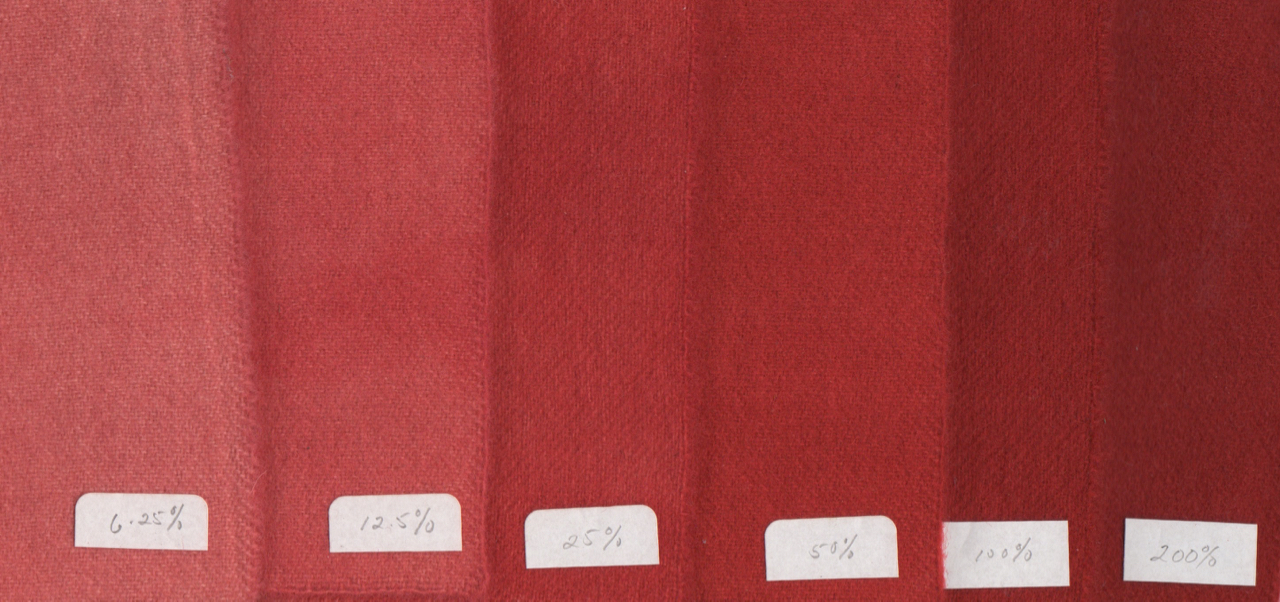
The fabric was dyed with the extracted liquid. The amount of dye ranged  from 6.25% w.o.f. to 100% w.o.f. I also did exhaust baths of the dye.

P1080249
Madder exhaust bath, linen

Madder is an interesting dye because it contains so many different colorants. The alizarin is what gives us the red, but it also contains other colorants: yellow, orange an brown. The initial dye at each depth of shade was dominated by the red. Exhaust baths contained less  red, while the orange dominated. The colors obtained from the initial dyeing at 50% w.o.f. and 100% w.o.f.were very similar but the stronger bath continued to give me red before the color turned more orange.

madder % 1
Dye % range and exhaust baths

The test was repeated  on wool with similar results.

madder % 3
Madder % range on wool

Dye extracts are what drew me back into natural dyeing but I’m finding that working with plant material is far more compelling. Each plant and dyestuff is unique and since these are natural products they are subject to the changes in growing seasons and processing. Testing my dyes in order to understand the nuances is time well spent. It will make me a better dyer.