Fermented Indigo Vat: Blog Post #2: Fermented Indigo Vats vs. Quick Reduction Vats vs. Chemical Vats 

© Catharine Ellis, as posted to the blog: Natural Dye: Experiments and Results

Fermentation vats are the oldest method of reducing indigo. These vats rely on the effect of bacteria present in an alkaline environment to cause the reduction that will allow the indigo molecule to become soluble. The bacteria existing in an oxygen-free environment is referred to as anaerobic. An indigo vat is reduced in anaerobic conditions. 

A “sukumo” vat, traditional in Japan, is a fermented vat that uses composted indigo leaves from the polygonum tinctorium plant as a source of the dye plus cellulose plant material that will help feed the vat. A sukumo vat contains no added indigo pigment. The preparation of sukumo is a lengthy process requiring the composting of indigo leaves after they have been harvested and carefully air dried.  
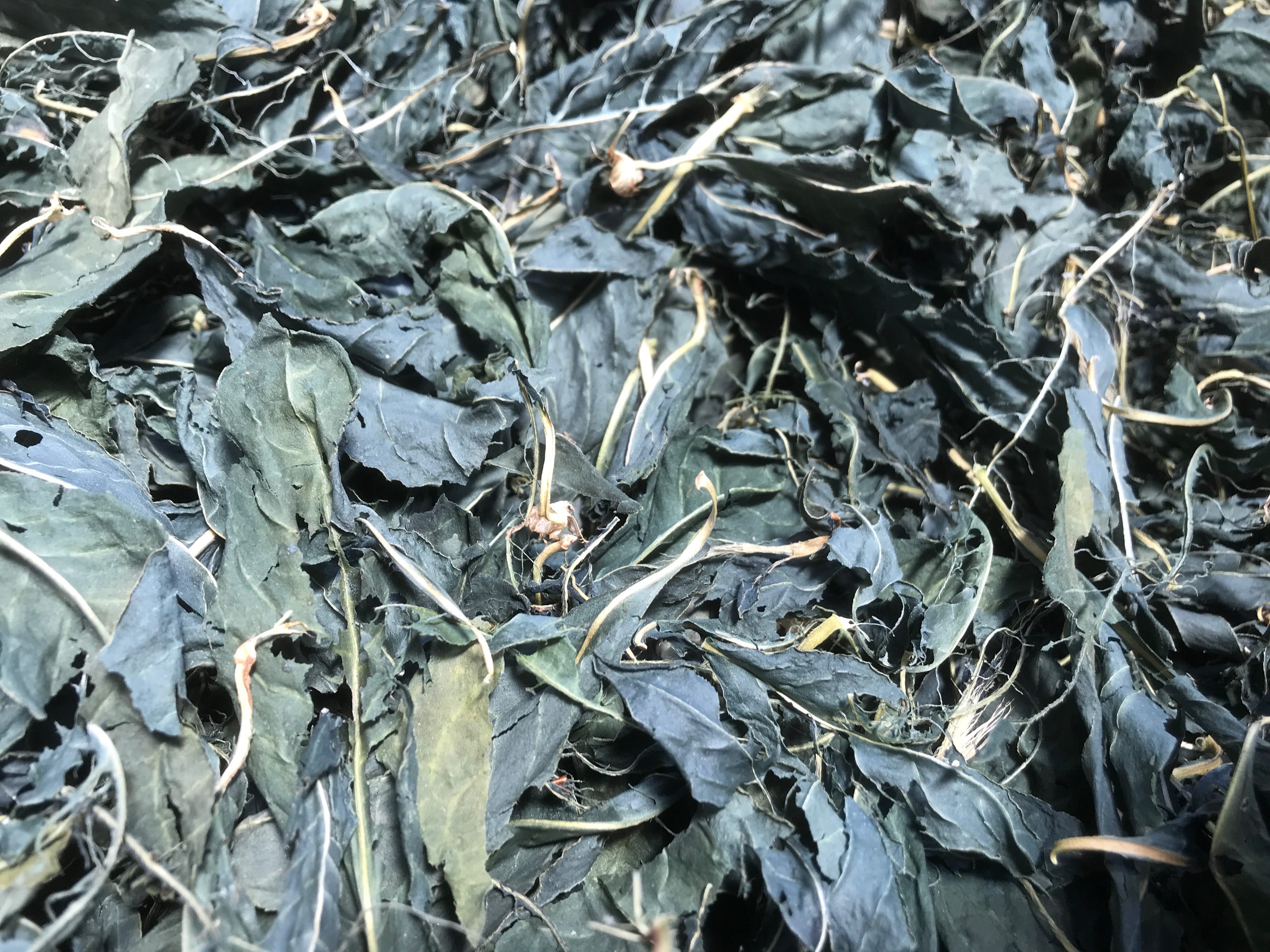
For those of us who do not have access to sukumo, it is important to know that a fermented vat can also be made using indigo pigment. This is the approach that was often used by 18th century commercial dye workshops in Europe.  Since the pigment is inert, suitable sources of bacteria and “food” for that bacteria must be added to the vat. 

•       Advantages of the fermented vat: A fermented vat uses a lower pH (9.5-11) versus the quick reduction vats, which makes it suitable for both protein and cellulose fibers. The correct pH of a fermentation vat can be obtained using wood ash lye, soda ash, or potash. Only small amounts of lime are used throughout the life of the vat to maintain a correct pH. These vats are suitable for long-term use, provided they are maintained correctly. That is something that will be covered.

•       Challenges of the fermented vat: Typically, the vat requires 7 -14 days to reach full reduction, but I have seen it take as long as 30 days. The vats must be carefully monitored and maintained by making regular additions of lime and organic material to maintain appropriate pH levels and insure a continuous source of bacteria.

Quick Reduction vats, though used historically, were re-introduced to contemporary  dyers by Michel Garcia and have gained great popularity amongst contemporary practitioners. These are the vats that we presented in The Art and Science of Natural Dyeing. They are easy to make. They rely on the use of sugars, fruits, plants, or minerals and require a very alkaline environment (pH 11-13) to achieve reduction. This high pH necessitates the use of significant amounts of lime (calcium hydroxide) as an alkali.

•       Advantages: These vats reduce quickly – usually in a day (or less). They use no harmful chemicals, though they do require working with a very alkaline substance and solution. Vats made with reducing sugars can be kept for several weeks and, with careful and regular maintenance, can be used for several months.

•     Challenges: The high pH is not suitable for all fibers (a high pH will damage protein). The large quantity of lime (calcium hydroxide) used to achieve the pH builds up quickly in the vat. The lime is also very difficult to remove from the finished textile and can compromise the dye and color, possibly resulting in “unexplained” fading of the blue. 

Chemical Vats use either sodium hydrosulfite or thiourea dioxide to reduce the indigo molecule. This process is used extensively in industry, and I know that some hand dyers also use this process, as it is very predictable. 

•      Advantages: Complete reduction takes place very quickly – usually within minutes. The pH of the vat is 10-11. 

•     Challenges: Reduction chemicals can potentially have a very detrimental effect on the lungs and health of the dyer. When used in combination with a high pH, they can also damage the tactile qualities of wool fibers. Personally, I do not like the smell of the chemicals. 

Because reduction is so complete using reduction chemicals, it can be challenging to achieve pale colors when using chemical reduction.  It is also difficult to use multiple immersions in the vat to increase the depth of shade, as repeated immersions will re-dissolve the indigo already incorporated in the textile.    
Fermented Indigo Vat #1:  A Journey from Quick Reduction to Slow Fermentation

© Catharine Ellis, as posted to the blog: Natural Dye: Experiments and Results

On this blog site, I have previously written about the indigo fermentation vats in very general terms. I have been using these fermentation vats exclusively for over 5 years now and I feel strongly that it is the best approach to use for indigo dyeing. So, I have made the decision that I would like to share much more specific information regarding how to make and maintain these vats through a series of posts in coming weeks. I hope to roll a new one out every few days days or so.  

Since I began the transition to using ONLY natural dyes in 2008, I have continued to learn and to refine my practice. Dyeing with indigo has been one of the most rewarding, yet challenging adventures. Striving for, and practicing a level of mastery related to indigo dyeing, is necessary to achieve a full palette of color using natural dyes and having the ability to control shades of indigo blue is a necessary skill. 

In the 1970s, I did my first indigo dyeing using sodium hydrosulfite as a reduction agent for my vat. I never liked dealing with the reducing chemicals, such as sodium hydrosulfite or thiourea dioxide. The smell was off-putting and, more importantly, I had concerns regarding the safety of such chemicals.  I abandoned their use (and indigo dyeing) until many years later.

I was thrilled when I learned from Michel Garcia that indigo vats could be made using benign substances such as  sugars, plants, ferrous sulfate, and lime (calcium hydroxide) which I was able to purchase in the grocery store as “pickling lime”. Vats made this way are considered to be, or described as,  “quick reduction” vats. They reduce and are ready for dyeing within hours and can be maintained for an extended period with proper attention. I was very happy. These are the vats that Joy and I included in our book “The Art and Science of Natural Dyes”.  I believe that these are still the best vats for short term dyeing workshops and other situations where a working vat is required quickly.

Over time, though, I observed that there are issues and challenges with these vats.

Crocking (the rubbing off of color) was a problem, despite proper finishing and  washing, and especially when dealing with knitting or weaving yarns, which are handled a great deal.  All indigo dye seems to exhibit poor resistance to rubbing to some extent, but the quick reduction vats seems to crock more. What I understand is that excess calcium may react with the reduced indigo and makes it into insoluble compound. These vats depend on the use of large quantities of calcium (calcium hydroxide). I am now thinking that it is possibly the reason for the bad rubbing fastness or crocking.  

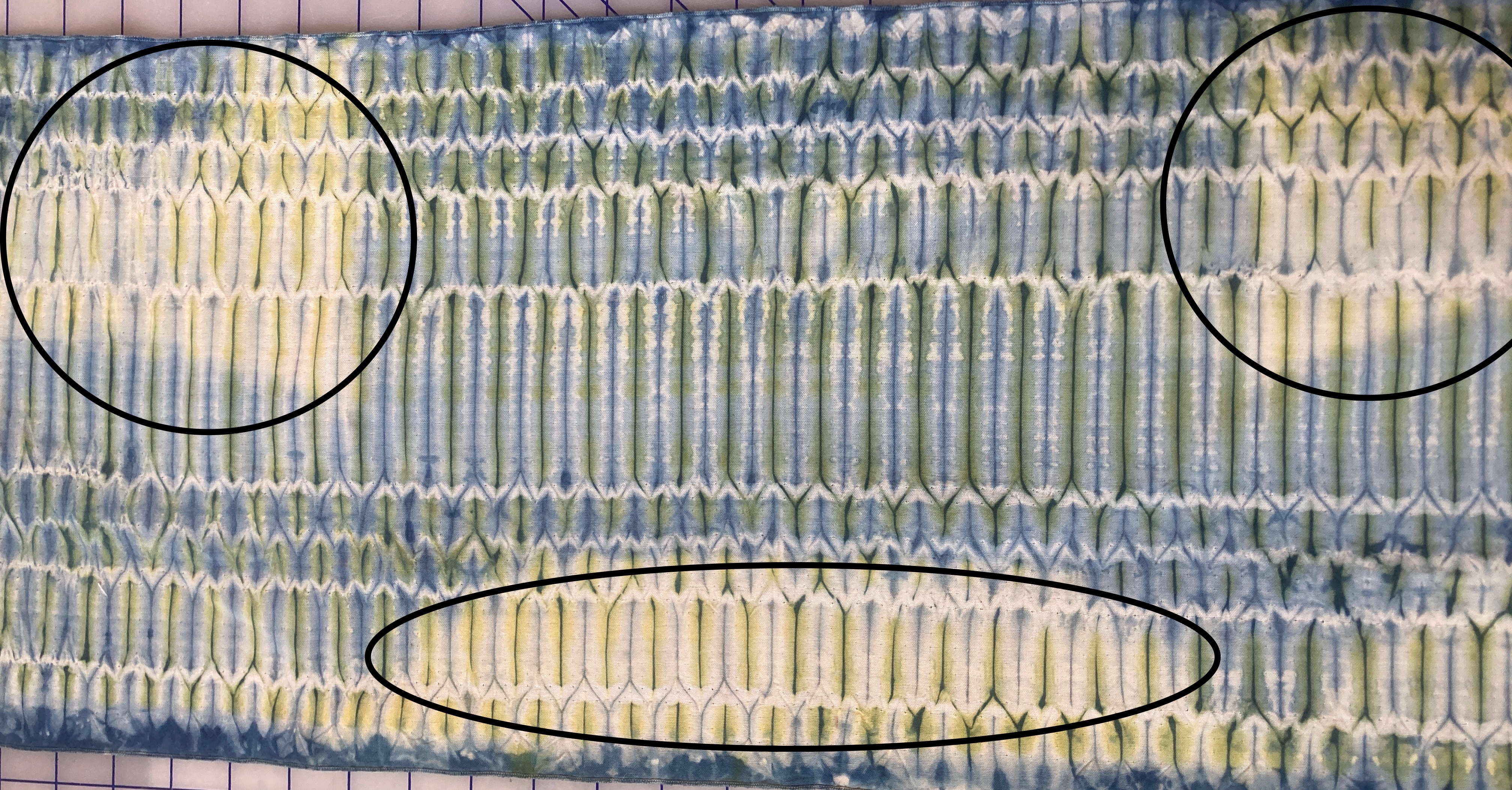
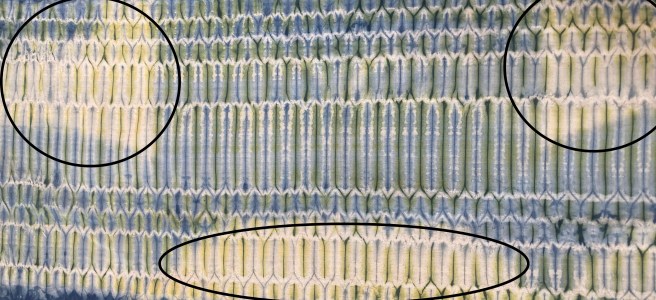
This shows the “fading” which occurred on the folded cotton cloth that was stored in a dark place for a number of months. The indigo blue has nearly disappeared in some places. The fading mirrors the actual folds that were in the cloth. It is NOT an intentional design element.

The color often faded inexplicably, turning pale and displaying washed out areas, or just completely disappearing.  I have observed this occurred where cloth was folded and put away on the shelf.  Even when a textile was rolled up and stored in the dark, I would find that the blue had literally disappeared in some parts of a textile despite careful finishing and neutralization. I’ve had discussions with other dyers who have also experienced this same phenomenon, so I know I am not the only one who took note. I always do lightfast test on the dyes that I choose to use for my work but this was something else entirely

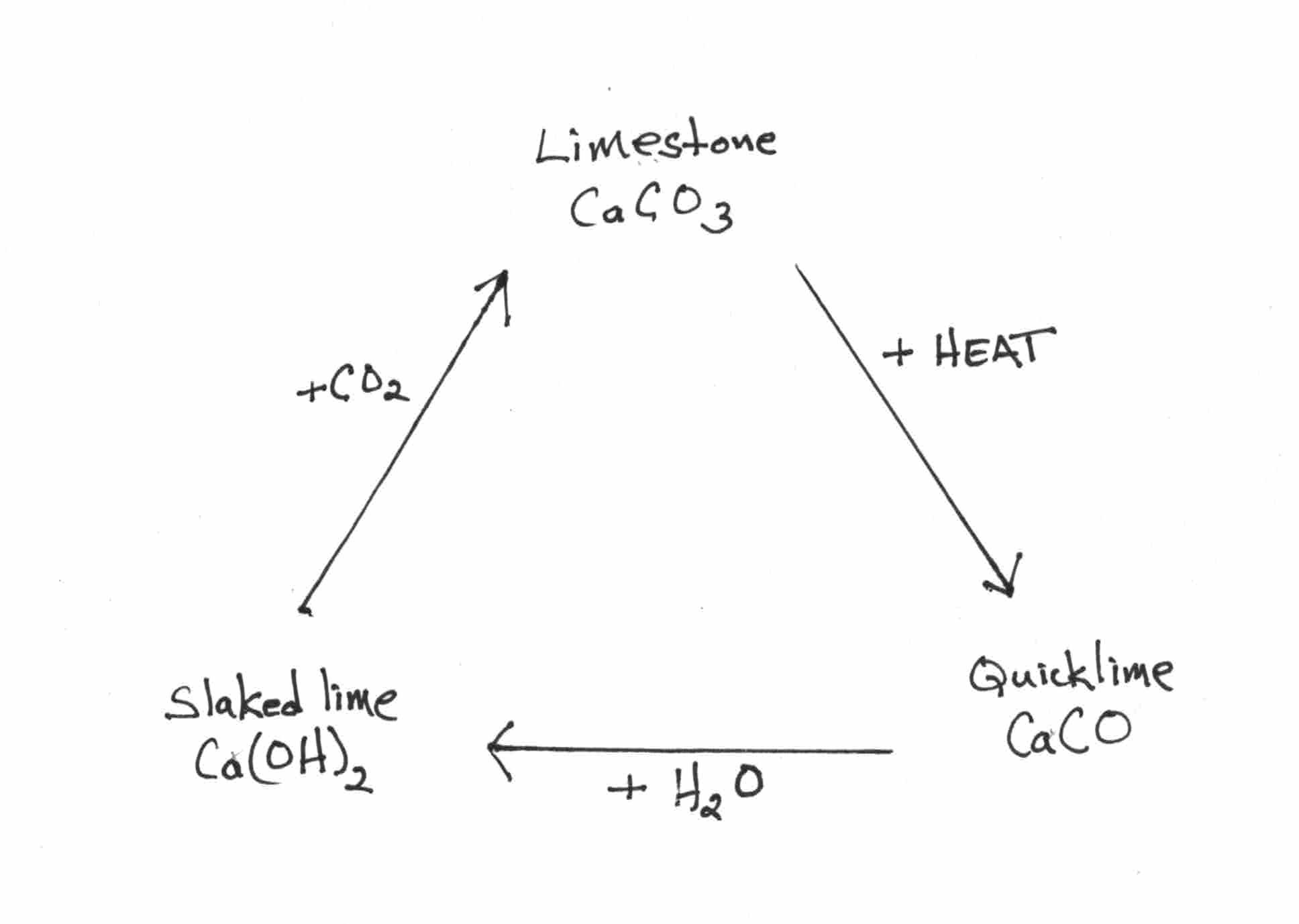
The “lime cycle” illustrates how limestone is heated to create quicklime. Water is added to make slaked lime. Does exposure to air/carbon dioxide turn the lime back into limestone again?

In 2017 I began my journey using indigo vats that reduce by the activity of fermentation  after meeting Hisako Sumi, Japanese indigo dyer and researcher. Hisako encouraged me, guided me, and even put together and gifted me a small “kit” which she mailed from  Japan, so that I could start my first fermented vat.  I began experimenting, testing, dyeing, observing, and never looked back. Hisako generously ‘coached” and mentored me from from her home in in Hokkaido and provided me with a much deeper understanding of my vats.

The COVID pandemic kept many of us home for long stretches of time, and during that period many of us learned new skills or honed old ones. That time provided me the opportunity and focus to tend indigo vats and to develop and refine an understanding of the fermentation process. My indigo dyed textiles have never been better! I no longer fret over potential “unexplained” fading. The quick fermentation vats require high alkalinity (pH 12). The fermented vats are able to be maintained at a lower pH than the quick reduction vats (pH 9.5-11). This is accomplished by the use of wood ash lye, soda ash, OR potash to achieve the correct pH. I have used all of these alkaline sources  successfully. Lime (calcium hydroxide) is used in very small amounts and only to “tweak” the pH maintain desired levels. The lower alkalinity of the fermented vats is more suitable for all fibers.  I will likely never return to quick reduction vats, unless specific circumstances require their use.        

In some of my previous blog posts, I have written about this process in general terms and also have given credit to Cheryl Kolander, whose online recipe was a good starting point for me, but until this time, I was not ready to publish anything definitive of my own. In fact, I have never published an “actual” recipe on my blog: Natural Dye: Experiments and Results

I am not a trained scientist/chemist, but through experimenting and multiple observations I have done my best to understand what happens in the fermented indigo vat so that I can use and maintain the vat. And now it is time to share that specific information and information about the process I have used. Over the coming weeks (and about a dozen blog posts) I hope to “walk through” the planning/making/maintaining of a fermented vat and to encourage and guide dyers to explore on their own. And, as we approach summer in the northern hemisphere, it is a good time to try these vats. But do keep in mind, fermentation vats may not be the best for a beginning dyer or for someone who does not have the time and focus for it.

One does not do this alone. I owe much to Hisako Sumi, Michel Garcia, Joy Boutrup, Dr. Kim Borges of Warren Wilson College, and to all my colleagues and students who have been willing to experiment with me. 

As a dyeing community, perhaps we can all help each other to learn, understand, and to work through the process of indigo fermentation. Your comments are most welcome. My goal is to start that process with a series of blog posts that might help you begin your own journey. By all means, if you have a “dye mentor”, do consult them! I don’t have all the answers but maybe we can get there together.

The Fermented Indigo Vat: an Introduction

Last year, I made the decision to stop travel/teaching. It’s been a long journey since my first weaving in 1970, my first dyeing in 1972, my first teaching in 1976 and my committment to natural dye in 2008. This year I will turn 74 years old. I am also a grandmother for the first time and am actively involved in the unfolding life of a 18 month old little boy (who makes us smile every day).

What I have not done, is to stop learning, exploring, or asking questions about natural dye, dyeing,  weaving, and/or how they might combine. Slowing some things down in my life is giving me to time to think more deeply about others, particularly indigo fermentation.  

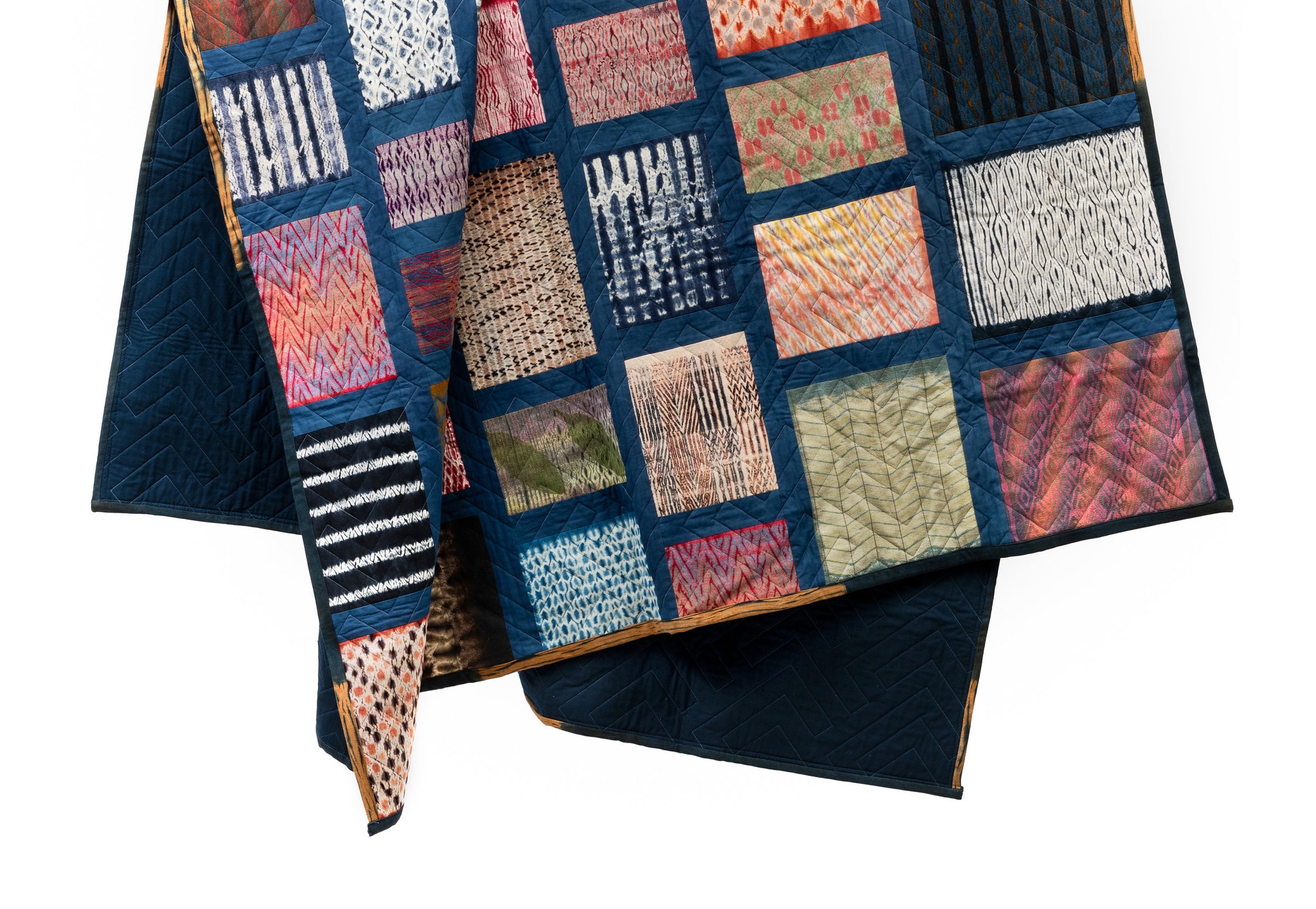
“Lessons”, a queen size quilt by Catharine Ellis using early woven shibori samples. Border fabric has been dyed with indigo using a fermentation vat.

Some time ago, Joy Boutrup and I discussed the possibility of another dye book that would expand what we presented in The Art and Science of Natural Dyes (Schiffer, 2019). While contemplating this dilemma, I came across the following quote from Annie Dillard:

“One of the things I know about writing is this: spend it all, shoot it, play it, lose it, all, right away, every time. Do not hoard what seems good for a later place in the book or for another book; give it, give it all, give it now. The impulse to save something good for a better place later is the signal to spend it now.
Something more will arise for later, something better. These things fill from behind, from beneath, like well water. Similarly, the impulse to keep to yourself what you have learned is not only shameful, it is destructive.
Anything you do not give freely and abundantly becomes lost to you. You open your safe and find ashes.”

Annie Dillard

So now, Joy and I have together made the decision that I would share the information I have learned using blogposts, instead of writing another book.  
Through a number of upcoming posts, I will discuss the process of indigo fermentation vats, the experiments I have done, and what I have learned about making, maintaining, and dyeing in those vats. I will explain, to the best of my ability, what is happening in those vats and why.  Hopefully, this will encourage more of you to try fermented indigo vats and will provide enough information for a high likelihood of success.  Each post will contain a link to a downloadable pdf version, which you are welcome to print and kept for studio reference.  I would ask that you be respectful of this information though you are most welcome to share the link to my blog for reference. 

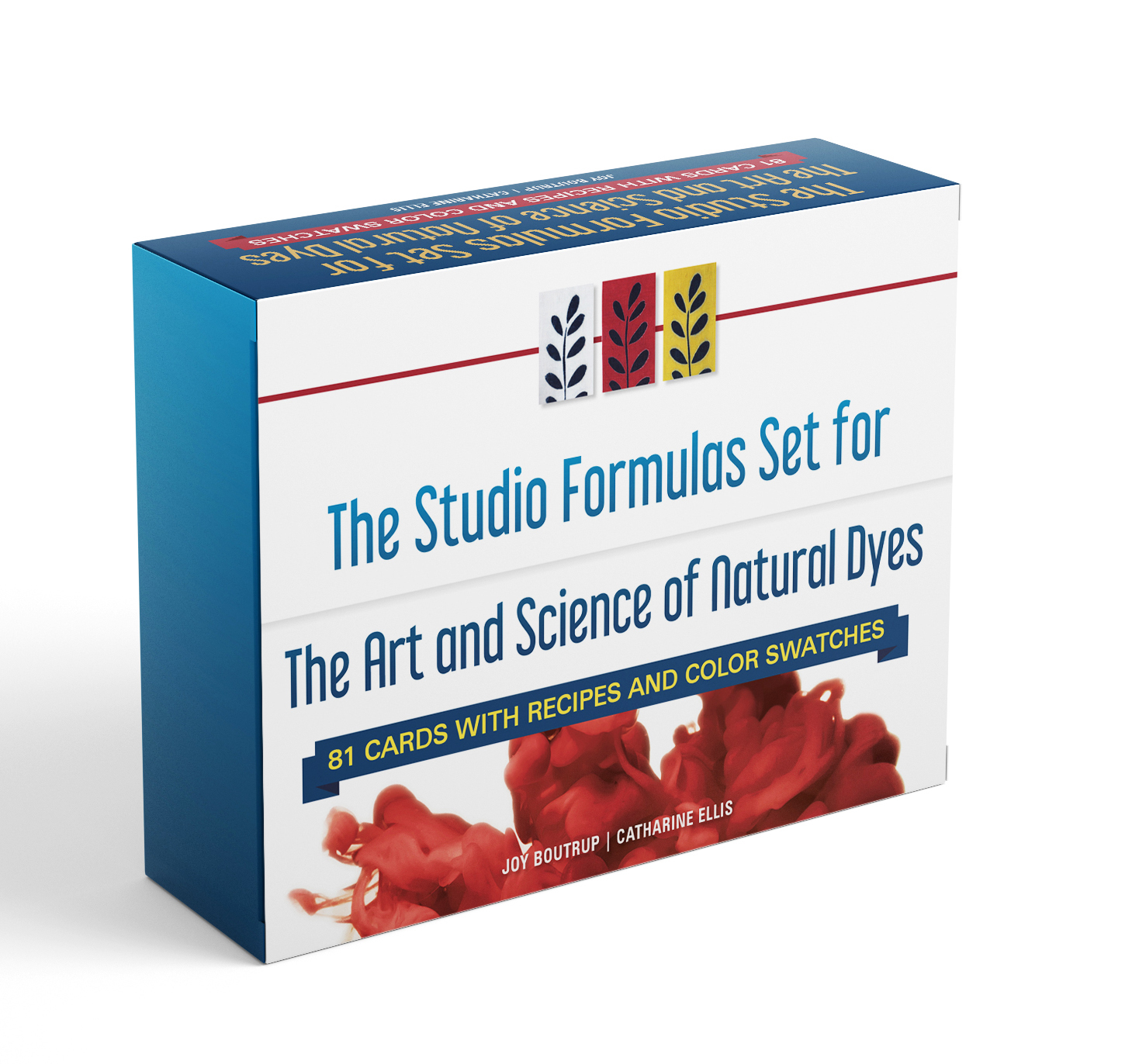
Dye Cards in a Box!

It has been a while since I have posted here, but I assure you that I am staying busy, still learning, and have been developing some new projects and ways of working. 

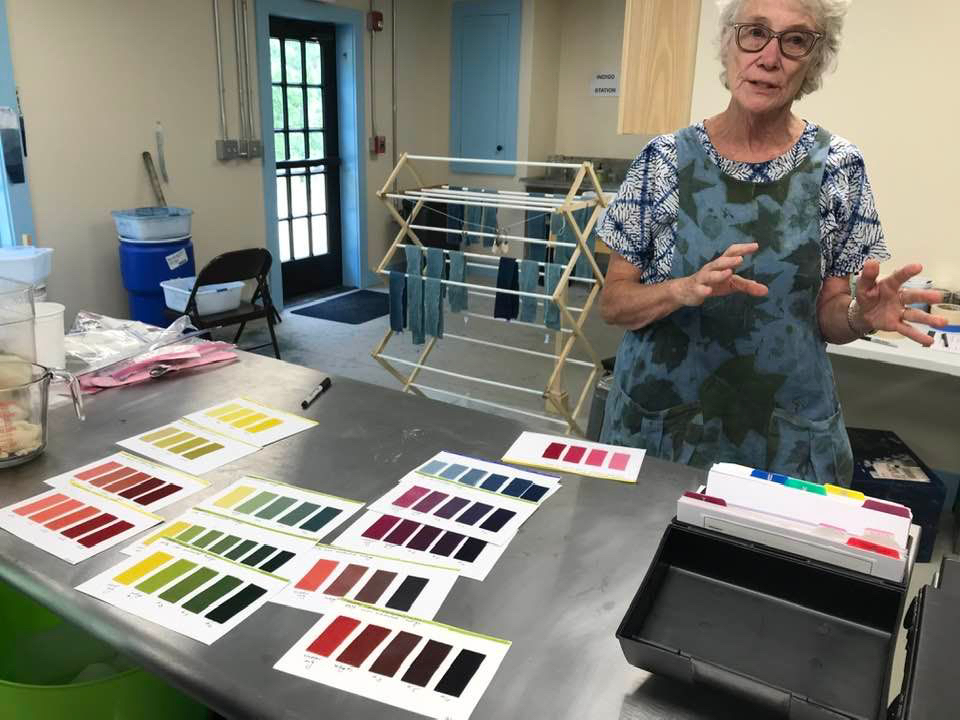
Last year, Schiffer Publishing Co. approached Joy and me about making the the recipes that are included in The Art and Science of Natural Dyes more accessible to the user. A we thought about how to accomplish this, I was reminded that in my household kitchen, I use the same recipes over and over again and used a recipe box and cards regularly. Maybe this would be a good idea for the dye kitchen as well. 

This invitation to increase the usefulness of the recipes seemed like a perfect opportunity to share the dye color work that I had been developing for many months in the studio and has finally resulted in The Studio Formulas Set for The Art and Science of Natural Dyes: 84 Cards with Recipes and Color Swatches. It is scheduled to be released by the end of June.

In 2020 I posted about Dominique Cardon’s newly published Workbook, Antoine Janot’s Colours. This little book has been a great inspiration to me. It was surprising and enlightening to find that Janot’s full palette of  55 colors was made with only 4 dyes: indigo, madder, cochineal, and weld. That bit of information has mostly changed the way I am now thinking about dyeing and color. 

When I first began using natural dyes I thought it was important to have/use/stock every dyestuff and dye extract that I could get my hands on; I didn’t want to miss any opportunity! The large number of dyes on the shelf always led to confusion when I got ready to dye. At some point,  I finally did lightfast tests on all the dyes on my shelf , making fastness to light a criteria for selection. Ultimately, I ended up with a much smaller number of dyes I was willing to use. Those are the dyes that we include in The Art and Science of Natural Dyes

The documentation in Janot’s workbook helped me to take color and color mixing to the next step, which was truly learning to master my dye colors. 

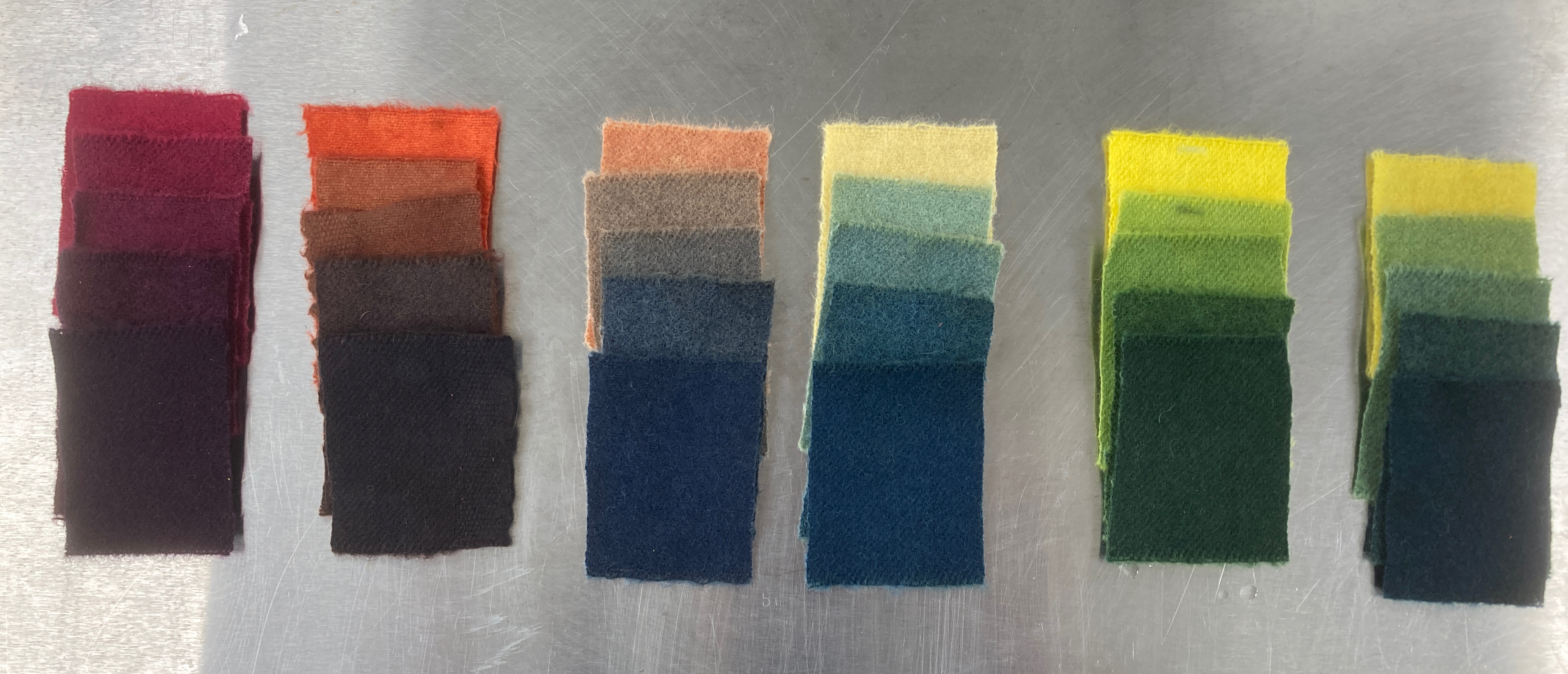
The first thing that I felt I needed to do was learn to control the various shades of indigo. Janot used 8 different shades of blue, each with its own name. I had to learn how to consistently achieve different shades with my fermentation indigo vats. My goal was 6 different values.  Dyeing consistent blues is like capturing a moment in time, as the vats change over their life span. My first fermentation vat was over 2 years old before it finally gave me the pale blue that I needed for some of the color mixes. 

The 8 shades of indigo blue used by Janot

The 6 values of indigo blue chosen for use on the cards and subsequent color mixing

So, I began dyeing a series of predictable, repeatable color using indigo and a handful of other dyes using various depths of shade.


Various shades of yellow from weld

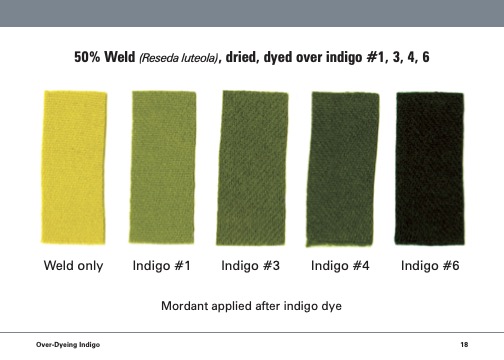
Various shades of indigo + a strong weld result in one set of green colors

The same shades of indigo with a weak yellow results in a different set of greens.

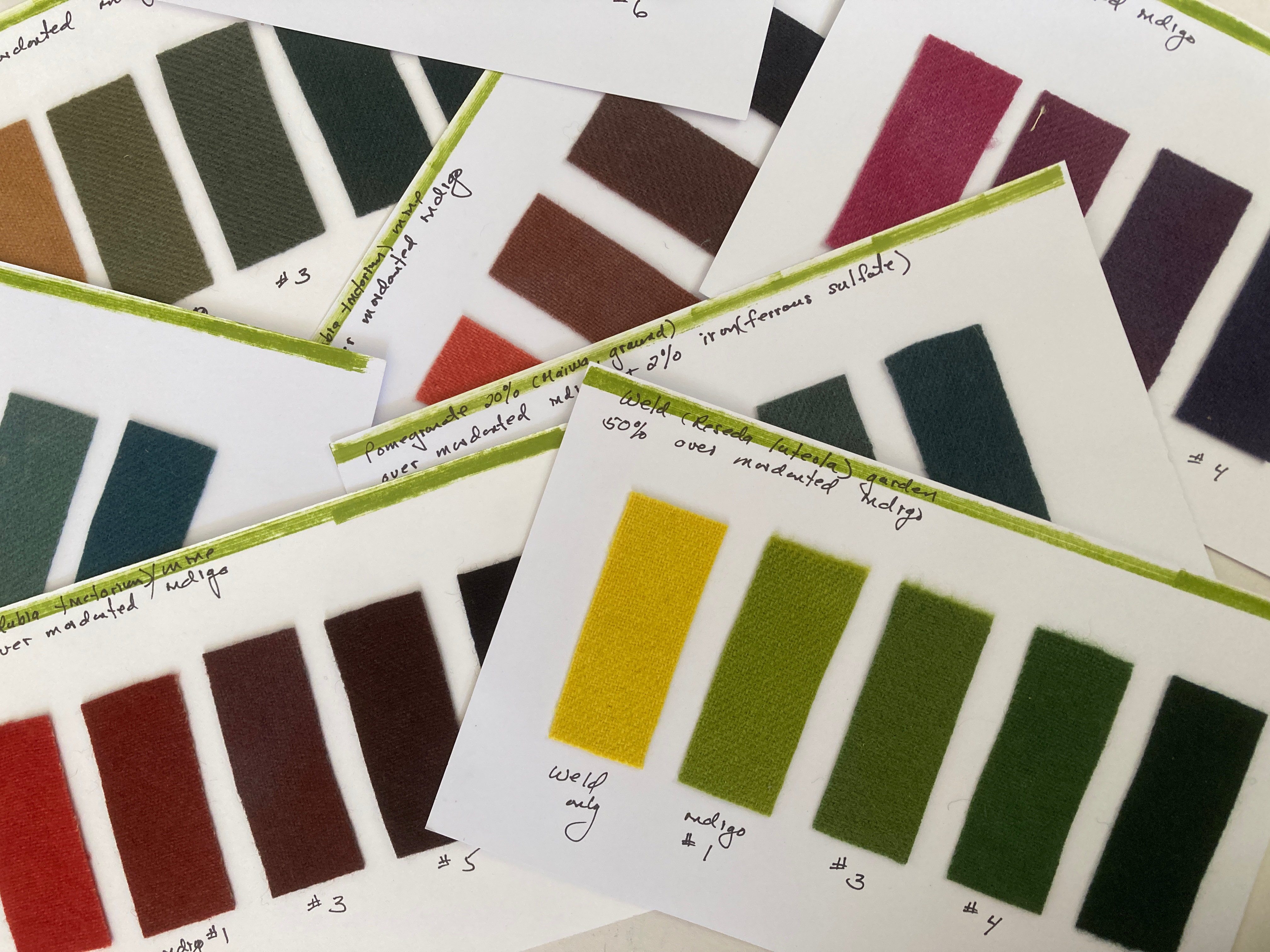
My lab notebooks are fabulous repositories of all of my testing (I am now on volume #10) but they are not always the most convenient place to go for a quick color reference. So, I began putting my color mixes and repeatable dye colors on cards – the  kind that you can file in a box for easy reference. And then I began USING that reference. It was at my fingertips and ready to look at whenever needed

My own first set of studio dye cards

I realized that this was also a perfect opportunity to combine the recipes from The Art and Science of Natural Dyes with a set of color mix cards, that will give the dyer some basic color mixing information. 

The dyes included in the color mix box are: indigo, cochineal madder, weld (and a little bit of the tannin dyes: pomegranate rind and cutch )

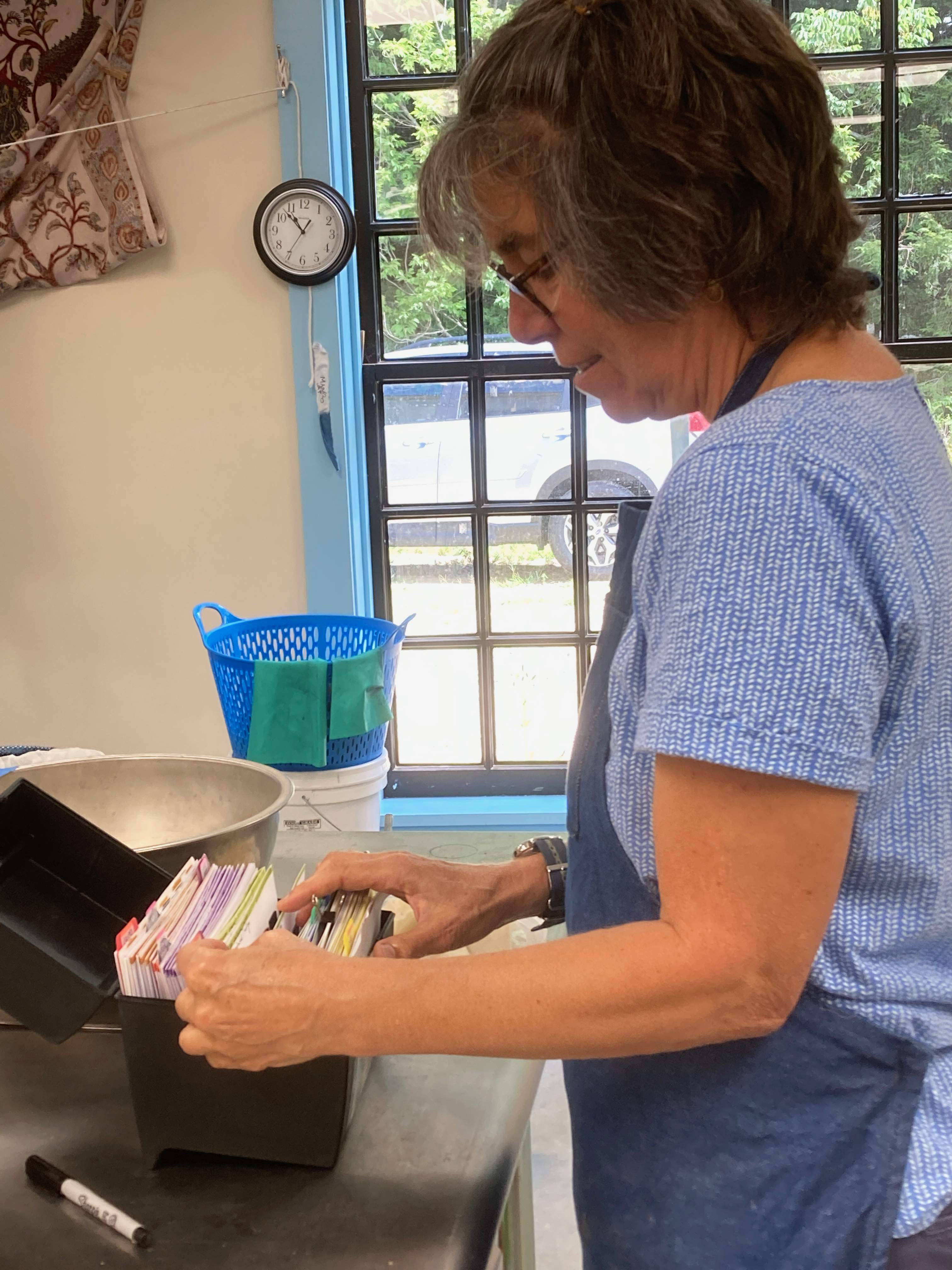
I have used my “box of colors” in teaching over the last months. It is rewarding to see students refer to the cards, make their own color choices, and their ability to achieve very similar results. 

To follow soon: ideas of how to best use your own set of “Box of Cards” in your own studio dye practice.

More Notes on The Life of a Fermented Indigo Vat

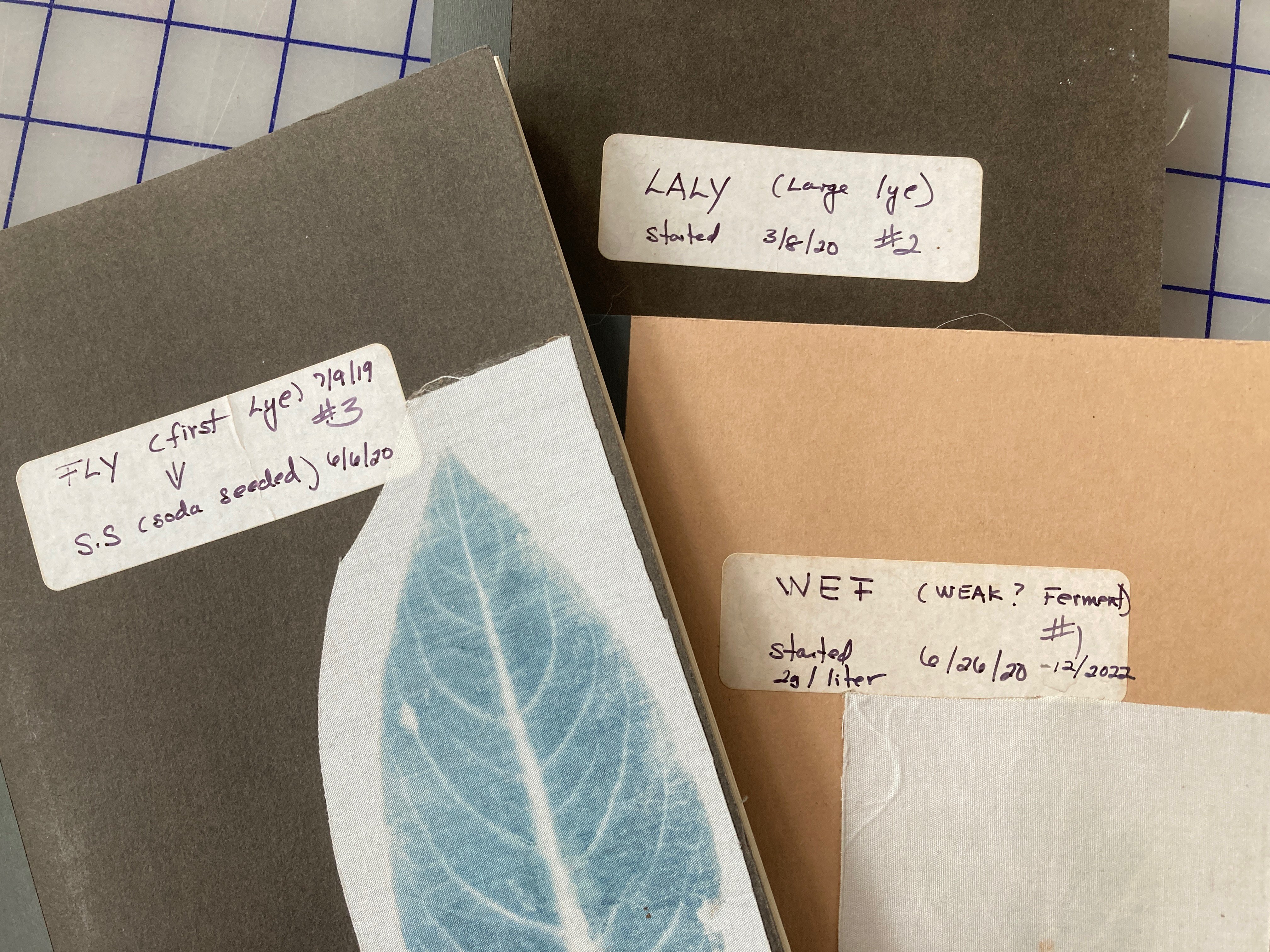
Vat name: WEF (WEak Ferment)

Dates: June 2020-December 2022

The early months of the Covid pandemic proved to be the perfect time to delve deeper into fermented indigo vats. As I have discussed in earlier posts, I began making small (1 liter) sample vats and learning from them. Ultimately though, in order to really understand how the vats worked and dyed, I needed to commit to something larger. 

I built my first large (50-liter) fermented indigo vats in early 2019.

All the fermented vats were made using indigo pigment.   Wood ash lye or soda ash was added to provide the alkalinity.  They all  included combinations of spent madder root, dried Indigofera tinctoria leaves, and wheat bran to produce the fermentation which, in turn, produces the reduction.  

I frequently add small test vats to  larger ones as I build them. This “seeding” speeds up the reduction quite a lot, resulting in vats that are sometimes ready for dyeing after only 2-3 days, rather than the 10-12 days that would normally be required. 

These fermented vats were giving me good strong blue colors. Yet, I was also trying to understand and control a full range of light to dark shades of blue. I needed a weaker vat. Based on my experience with quick reduction vats, I decided to make an additional “weak” vat, by using only 2 grams of indigo per liter.

Note: when working with quick reduction vats, such as a fructose vat,  I can easily control the depth of color by making weak vats (1-2 grams/liter) vs. strong vats (5-8 grams per liter). This combination of both weak and strong vats is very helpful in creating shades from light to dark, and  when combing indigo with other dyes for greens, violets, etc. 

In addition to “numbering” my vats I also “name” them, using a title that is descriptive of the vat itself. This one was name WEF (Weak Ferment). Initially, it did NOT produce the anticipated pale color that I had hoped for. The color was actually quite strong, even though it contained what I considered only a small amount of indigo, compared to the other vats. From this, I concluded  that the reduction of the indigo in the fermented vat was much more efficient than in the quick reduction vats. 

In order to achieve the desired pale color from the vat I needed to deplete the indigo present.  Traditional vats typically give the palest of colors at the end of their life and this was very much in keeping with that strategy.

I began dyeing a LOT: large woven panels, cotton and linen clothing, etc. Because this vat was large (50 liters) it was easy to dye bigger pieces in this vat. I continued dyeing for a number of weeks, which turned into months. Still, the color remained deeper than I had hoped for. This was a lesson in patience.

Early in 2022, while working on The Studio Formulas Set for the Art and Science of Natural Dyes, a new recipe and color match project with Schiffer Publishing (more to follow about that later). The color samples in this project required careful control of my indigo blues (as well as all the other dyes). I was happy to find that my original “weak” fermented indigo vat (WEF) was finally dyeing beautiful pale blues, while my two other vats were still producing deeper blues. Access to both weak and strong vats was key to controlling the shades of blue.  

Six values of indigo produced for The Studio Formulas Set

Dyeing continued in the “WEF” vat on a regular basis for several more months whenever pale blue colors were required.

Each vat that I make is accompanied by its own small diary/notebook. In that book, I include all pertinent information, such as the original ingredients, dates, ph records, test samples, additions etc.  It is “the history” of that vat and an invaluable part of its life and maintenance. Regular maintenance always includes test sample dyeing, which is an excellent indicator of the health of the vat, as well as providing a record of the color that the vat is currently producing. 

In December, 2022 the WEF vat was finally depleted. It was producing no more blue color and resisted all attempts to revive it. After 30 months of use, the vat was consigned to the compost pile. 

The other two vats are still going strong today. One of them seems to be on its way to producing paler colors. 

Discharging of Indigo Dye

It is my belief that learning about natural dye takes a whole community of people who are willing to experiment, observe, and share. The sharing has been the most rewarding part of my own journey in natural dyeing. I have met many dyers, both in person and virtually, who are willing to be part of that communal knowledge base.

While my co-author,  Joy Boutrup, and I were preparing and writing The Art and Science of Natural Dyes, we experimented with potassium permanganate, a strong oxidizing agent that can be used to discharge indigo. It provides a unique approach to removing indigo dye. When combined with resist, such as “itajimi” clamps, wonderful resist patterning will result.  Changing the chemical treatment will result in a “permanganate brown” color. When the textile is pre-treated with a tannin, it is possible to achieve even darker brown colors juxtaposed with the indigo. All of these recipes/processes are included in the book. 

But direct application or printing with the potassium permanganate proved problematic. Any gum used to thicken the mixture rendered it chemically useless for discharge. In the book, we included a resist paste made with soy flour and lime (calcium hydroxide) in order to achieve some controlled resist printing effects. I had learned to make this paste while in China and found that the paste could be used as a resist for the potassium permanganate solution.  Unfortunately, the soy/lime paste, although effective, is harsh and very difficult to remove from the textile. 
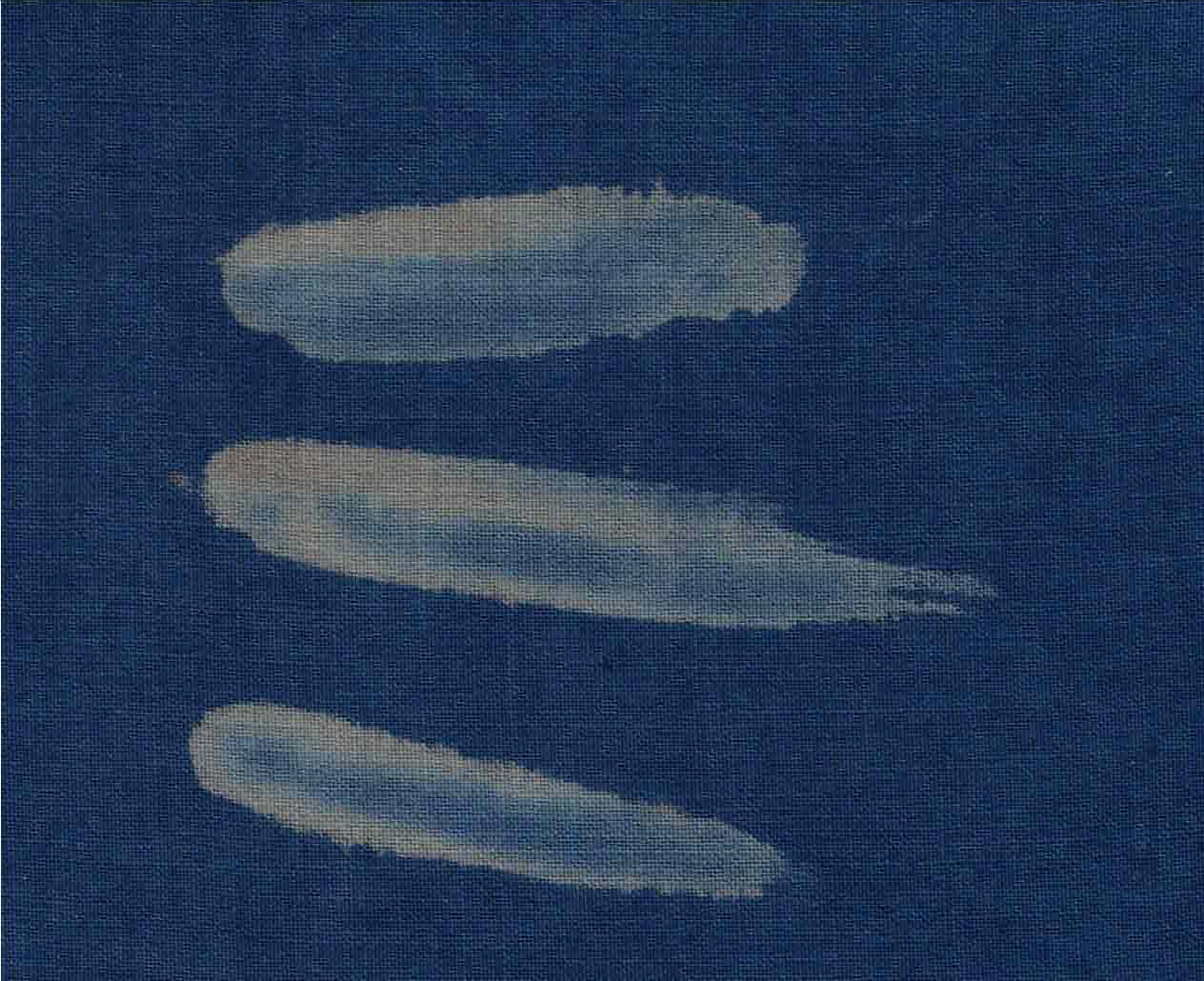
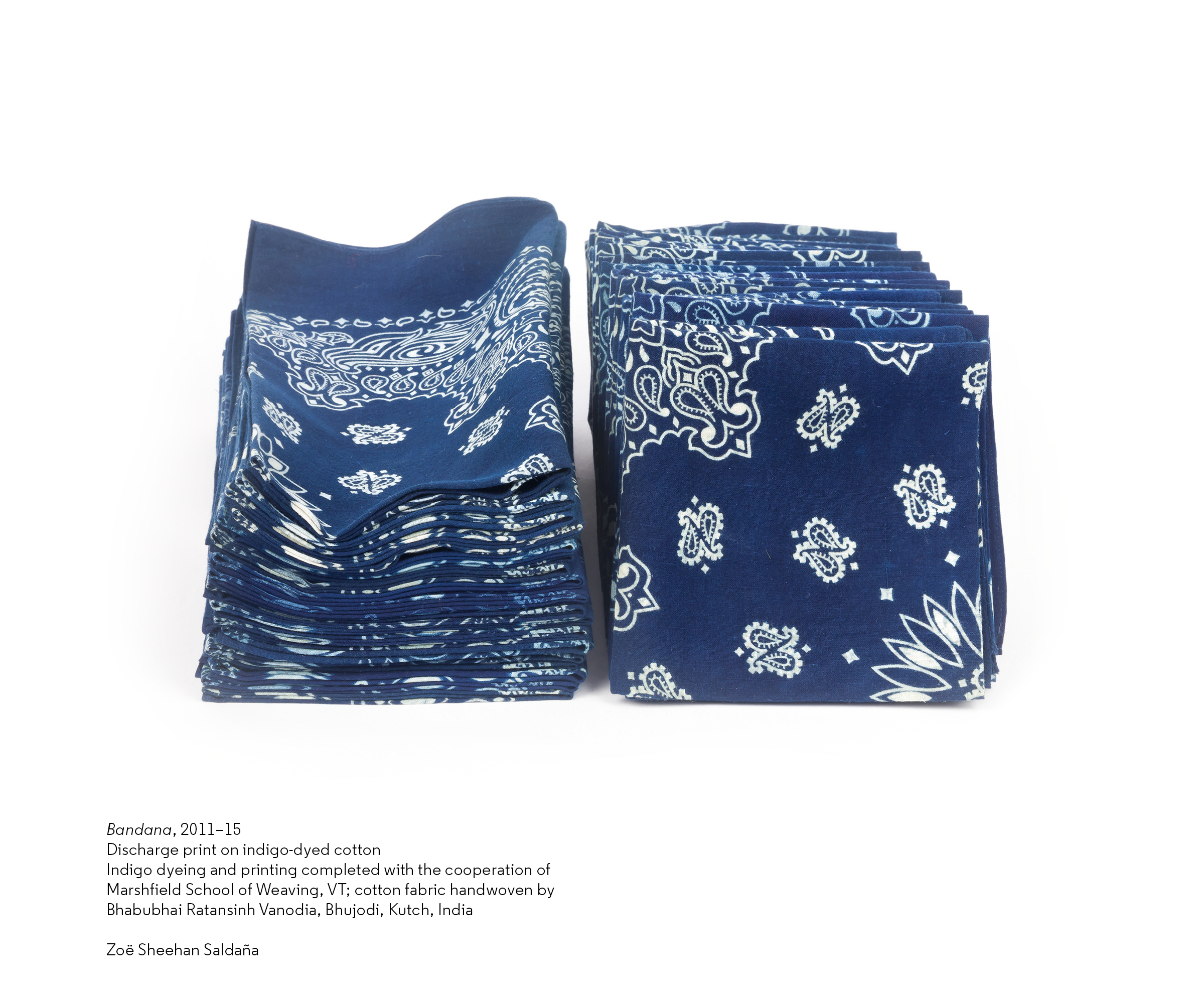
After The Art and Science of Natural Dye was published, we received an email from Zoë Sheehan Saldana, an artist who has been using potassium permanganate. She experienced the same challenges when printing – but she solved the problem by thickening the potassium permanganate with a fine clay. The clay is inert and does not interfere with the chemical oxidation of the indigo.  Either bentonite or kaolin are suitable clays. These are the same types of fine clay that are used with the indigo resist paste. The printed application of the paste in her bandanas results in an even discharge and the printed patterns become pure white.

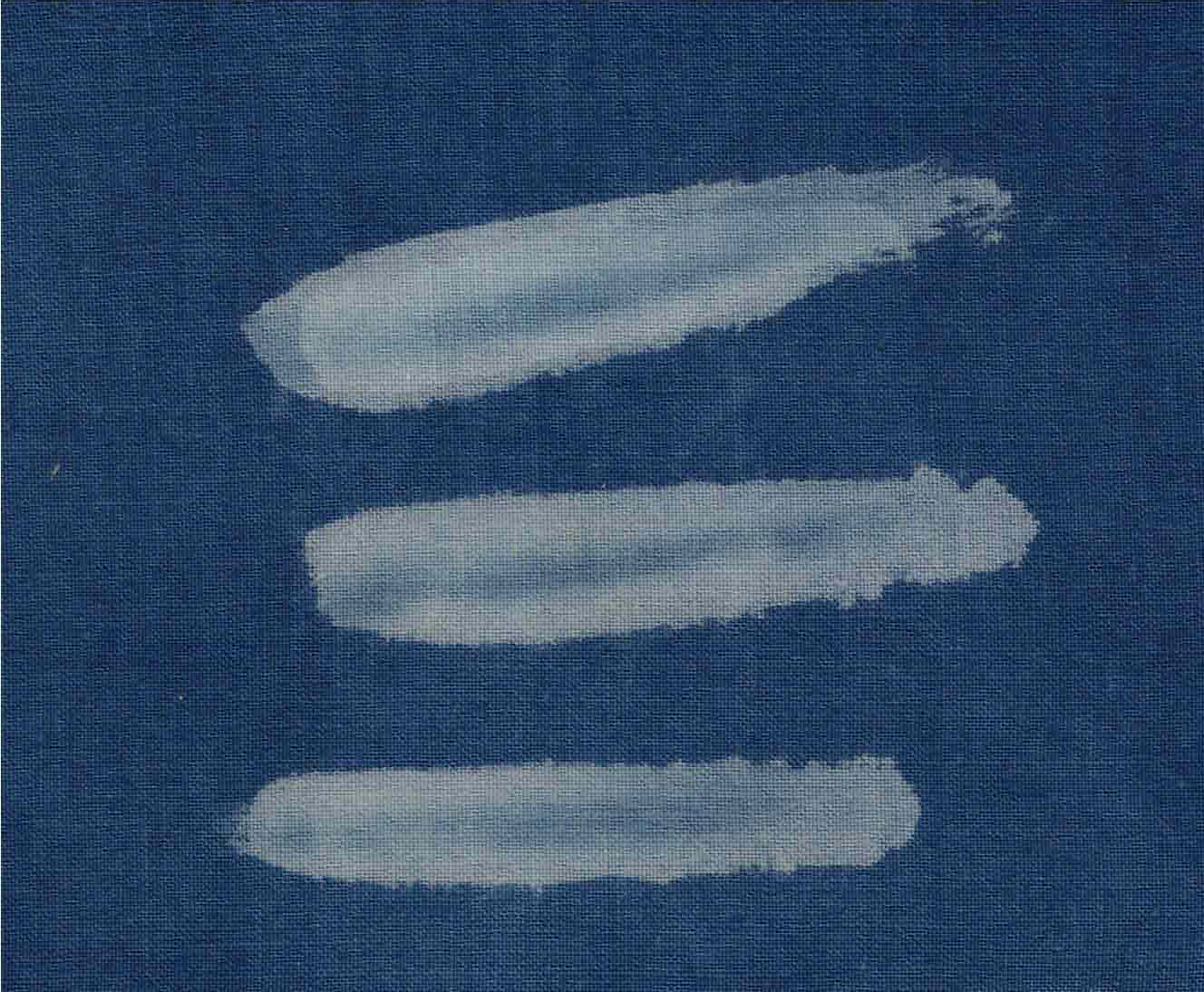
Use enough clay to achieve a suitable thickness for painting or printing with a screen. Varying the amount clay, as well as the application method, will result in hard lines or soft edges. When painted on, rather than printed, an uneven layer of the paste and the discharge can result.

Mix the paste in small batches, making only the amount that you think you will need.  The paste is most effective when used fresh, but if kept tightly covered it can last for a couple days.

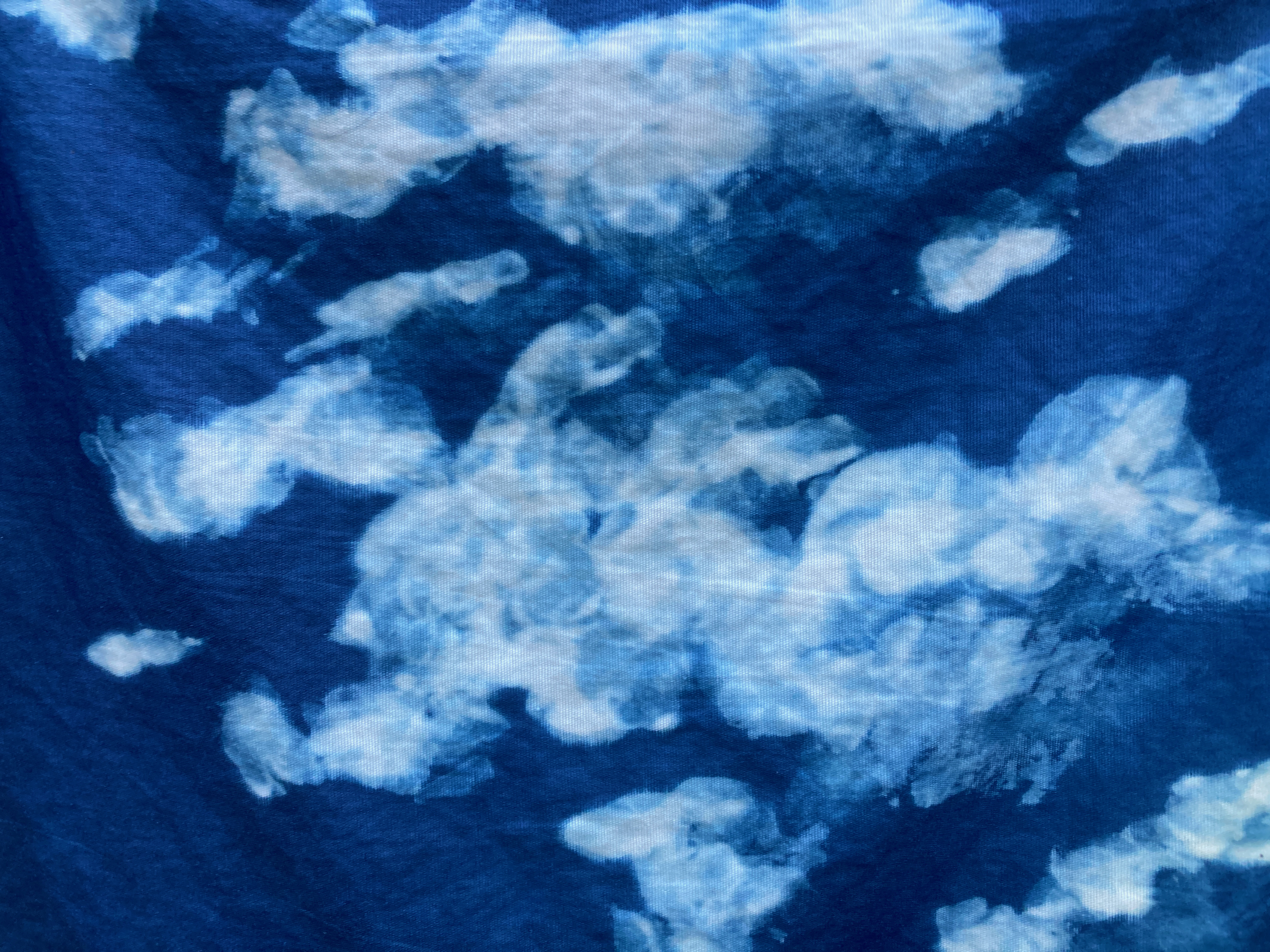
Indigo discharge, using a painted application, by Amanda Thatch. taking advantage of the uneven thickness of paste that results from the brushed on application.

During this week of the United States holiday of Thanksgiving, I am grateful for the community of dyers and experimenters out there, who are willing to share and make our knowledge base stronger. Thank you. Happy Holidays!

Madder for the Indigo Vat

It is exciting to see such a passion for indigo these days, and especially the active exploration that is happening. With this also comes with a deeper understanding of indigo dyeing and process. 

Vats reduced with chemicals such as sodium hydrosulfite or thiourea dioxide used to be the norm when I first learned indigo dyeing in the 1970’s. But now, many dyers have abandoned those chemical reduction vats and are returning to more benign processes. They are now making quick-reduction vats that are reduced with sugar, fruit, plants, or iron – thanks to the teaching of Michel Garcia. Some are growing their own indigo to explore fresh leaf dyeing and pigment extraction. Others are making sukumo – a long process of composting persicaria tinctoria leaves – Thank you Debbie Ketchum Jirik for offering an online class this past fall. Recently, Stoney Creek Colors has introduced a natural, pre-reduced indigo. And more dyers than ever are now exploring vats that are reduced by fermentation.

Fermentation is the process that has captured my interest in recent years. The long-term committment seems to fit my own “stay at home” life right now. The lower pH is suitable for all fibers. Most of all, it’s been an interesting adventure. Something that once felt out-of-reach has now become my preferred process. 

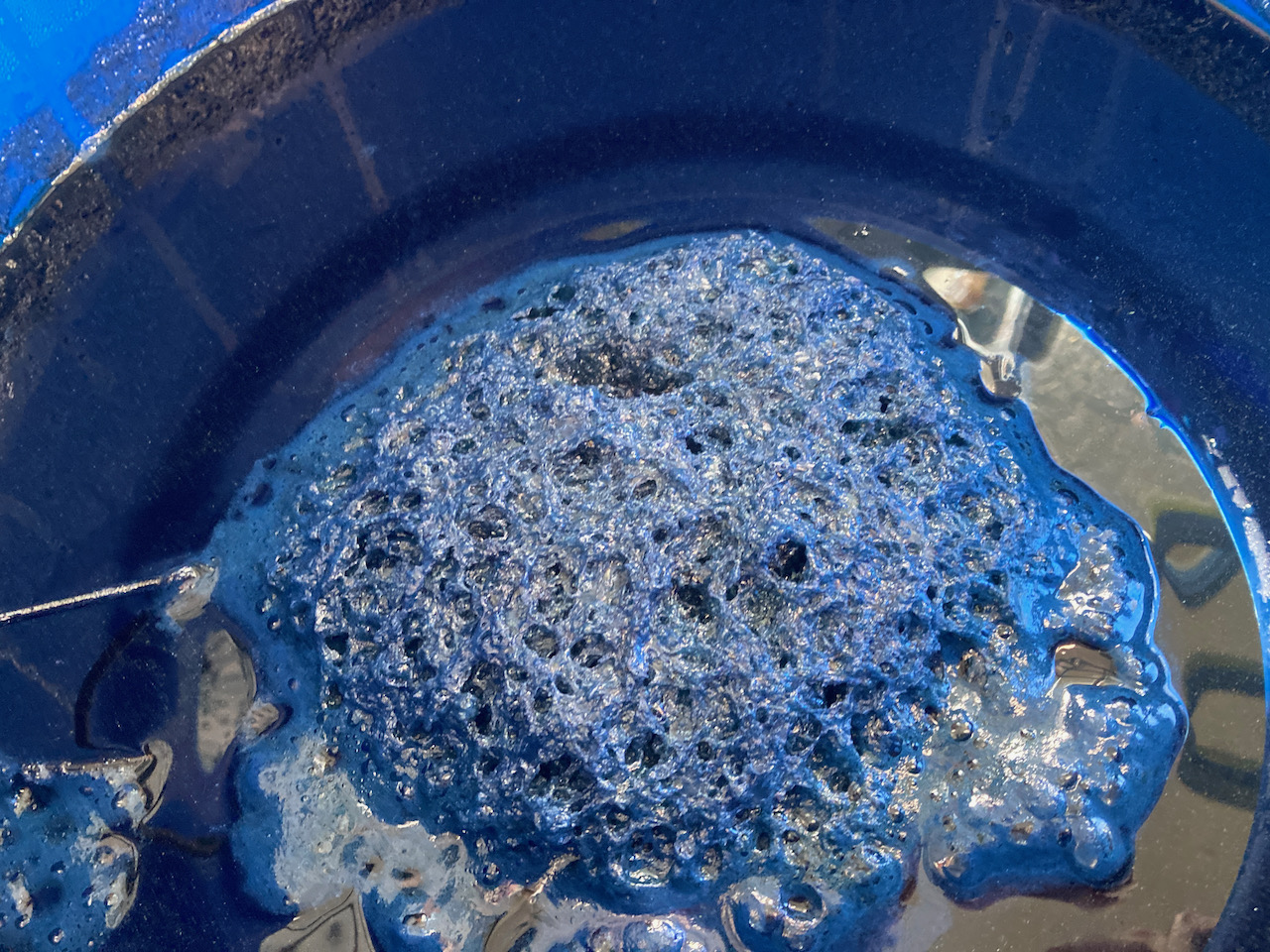
The fermentation vat utilizes plant material to initiate and maintain an alkaline fermenting process, which causes the indigo to become soluble. During fermentation, plant material is broken down, creating bacteria. Lactic acid is produced, making it necessary to monitor the pH on a regular basis. 

Madder root is a common plant material used in a fermentation vat. There is a long history of its use in indigo vats. It is usually combined with wheat bran, which ferments readily. There are many recipes in old manuals for this Madder Vat.

From The Dyer’s Companion by Elijah Bemis (originally published in 1815, Dover Edition, 1973)

for a vat of 12 barrels (not sure what a “barrel” is)

  • 8 lbs potash
  • 5 lbs madder
  • 4 quarts wheat bran
  • 5 lbs indigo

When I first leaned of these vats made with madder, I struggled with the idea of using perfectly good madder root to reduce an indigo vat. But I have now come to understand that these vats were most likely made with “spent” or “used” madder. I remember Michel Garcia talking about how the “used” madder from professional dye studios in the past was sold to the indigo dyers after it had been used to produce red dye. Indigo dyers have no need for madder’s red colorants and thus nothing was wasted. 

So, I am dismayed each time I hear from someone who has made a fermented indigo vat using “new madder root”. “Spent” or “used” madder is every bit as effective as a fermentation booster as fresh or “unused” madder. 

Most of the madder I use in the studio is in the form of finely ground roots, though chopped roots would work as well. When my madder dyebath is finished, I strain the ground roots and dry them for later use in an indigo vat. It’s that simple! And nothing is wasted. 

Equal amounts, by weight, of “used” madder root on the left, and “new” madder root on the right. Most of the colorants have been removed from the madder in the dyeing process, leaving only the starches and sugars of the roots.

Plant materials, other than madder,  can be used in the fermentation vats. I frequently use dried indigofera leaves, as well as woad balls and have even begun a “hybrid “ vat using sukumo with indigo pigment. My most recent experiments have used both Dock root and Rhubarb root successfully. Madder, Dock and Rhubarb are all roots, all anthraquinones…..

The Surprise of Indirubin!

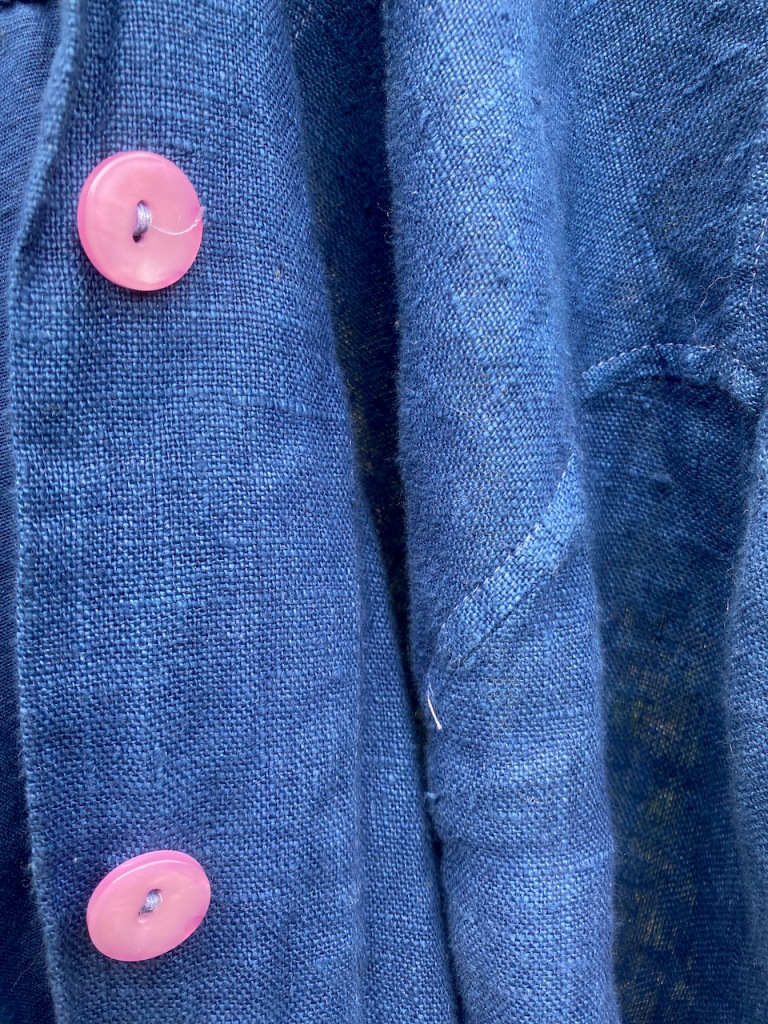
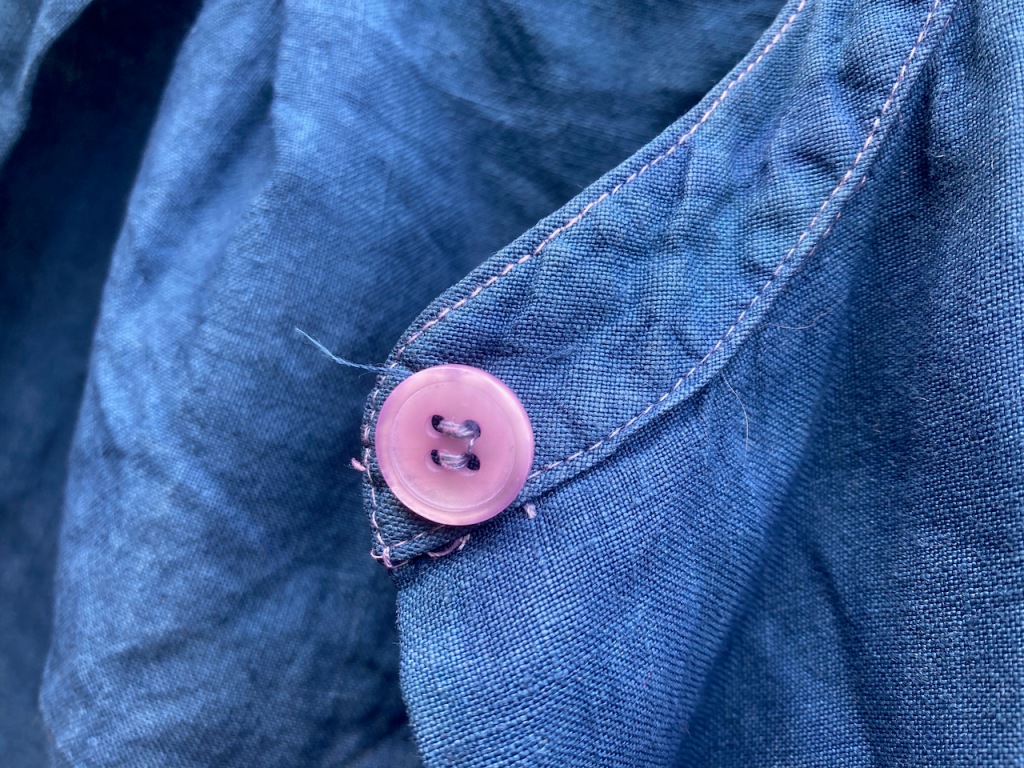
Why would a white plastic button turn purple from an indigo dyebath?

Indirubin is one the most curious components of indigo. It is sometimes referred to as the “red” of indigo. Indirubin only occurs in natural indigo and you will not find it in a synthetically produced pigment. Indirubin is valued for its medicinal applications.

Some dyers have been successful at manipulating the extraction and pH of indigo in order to reveal the mysterious purple/red color of indirubin on a textile. I have no real experience with this process.

At one point I did learn how to analyze an indigo pigment in order to determine the presence of indirubin. If indirubin is present, it is an indicator that the pigment is made from plants and not synthetically produced.  Natural indigo has varying amounts of indirubin. The process of analyzing uses solvents and chemicals so it is not something that I want to do on a regular basis. 

I purchase all of my indigo pigment from Stony Creek Colors, as I know that their indigo comes from plants (and, consequently, contains plenty of indirubin).

Now that I maintain several large “active” indigo vats, I will occasionally dye a ready made garment. A white linen blouse is not a good choice for wearing apparel in the dye studio, but one that has been dyed a rich indigo blue is perfect. 

After dyeing, just before the final rinse, I always boil an indigo dyed textile in order to remove any unattached dye. Cellulose is boiled vigorously with a small amount of neutral detergent for about 10 minutes. Wool and silk are brought to a near simmer and held at that temperature for the same amount of time. 

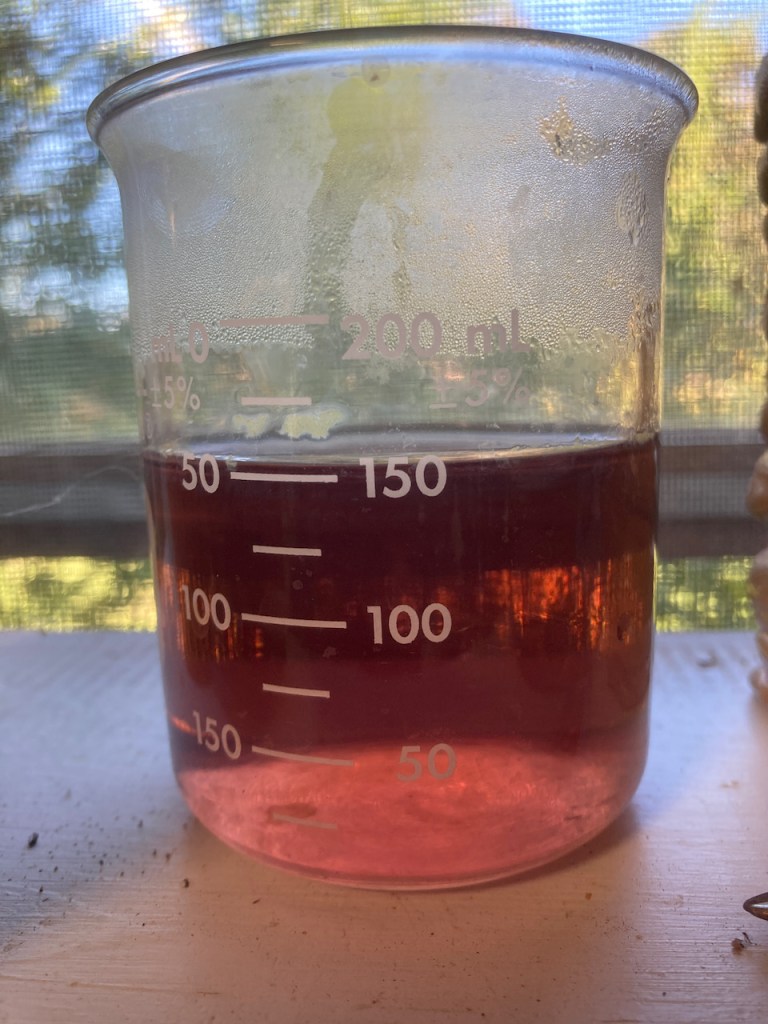
Once I started using indigo from Stony Creek I noticed that the water from the final boil was always tinted a purple hue. I assumed this was the indirubin that was being rinsed from the textile. Interestingly, I observed that the purple color in the boil water is temporary, and will disappear as the bath cools. 

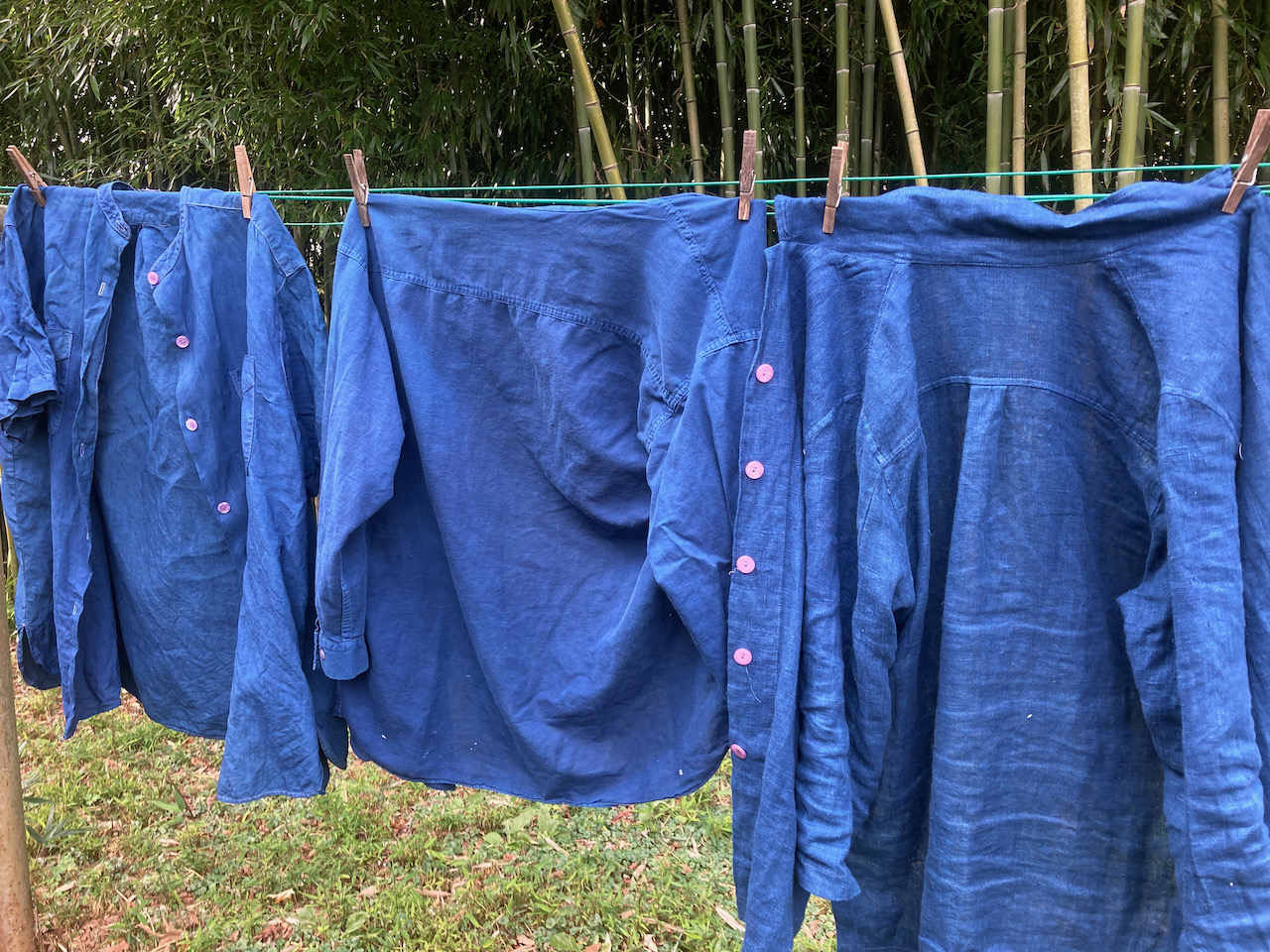
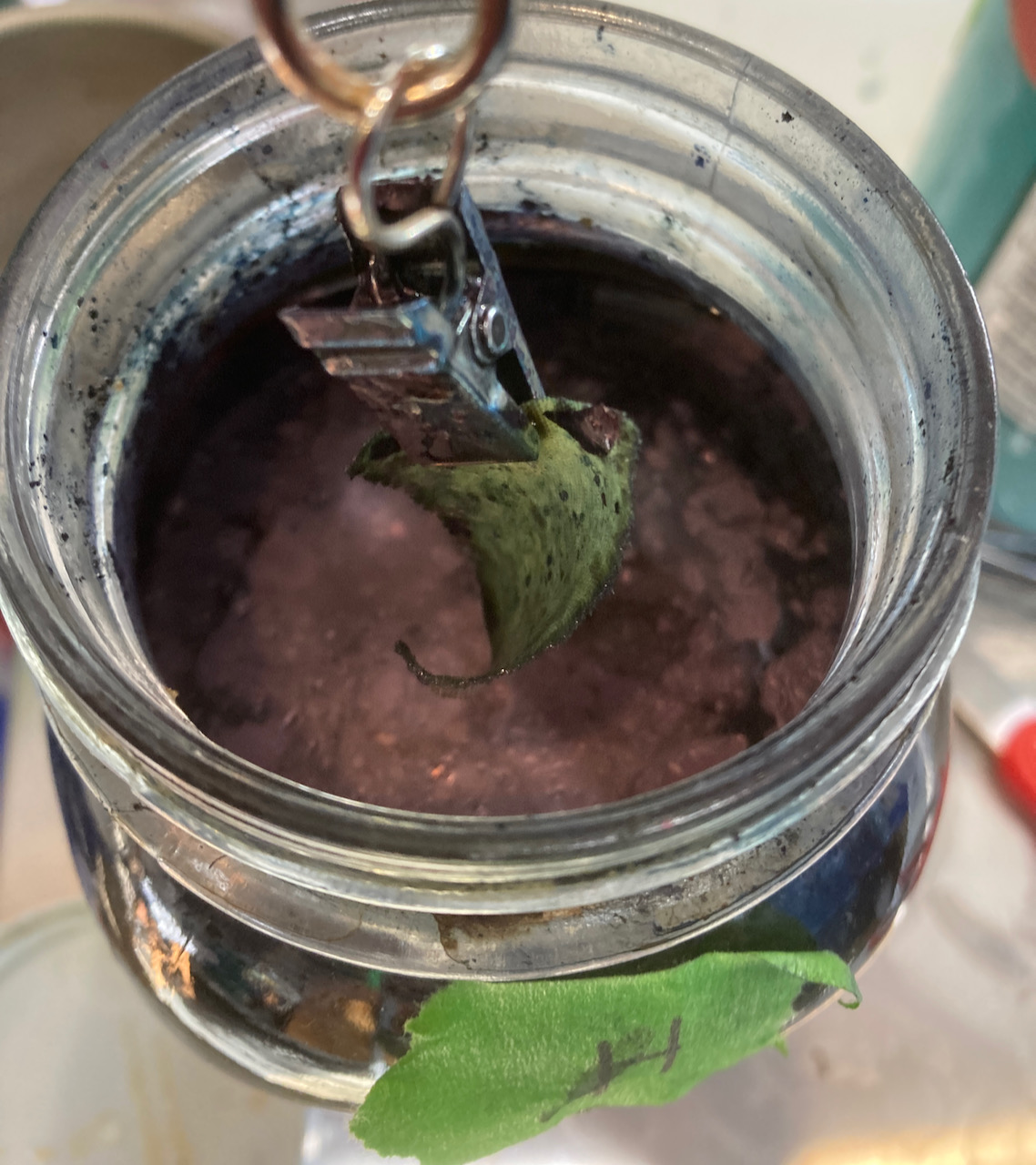
Recently, I dyed some linen shirts that had plastic buttons. The buttons stayed white until the final boil. When the garment was removed from the boil bath, they had become purple. I have now learned that indirubin is less easily reduced and the undissolved indirubin will stain plastics and other petroleum derived materials. Some of the polyester threads used to sew the shirts are also tinted purple. 
Summer Arrowood, the chemist at Stony Creek Colors, tells me that all the plastic vessels in her lab are dyed purple from the indirubin!

Will these buttons remain purple after multiple washings? I don’t know. There is always more to observe and learn from the natural dye process.
Slow Process

Natural dye has never been a quick way to color my textiles. First there is the mordanting, then the extraction of plant/insect material – not to mention growing, gathering, or drying the plants. Did I mention collecting seed? And what about the weaving, where I actually make cloth from threads? 

These last 18 months at home have been a chance to dive in deeper (and slower) with some processes. Just before COVID came to our doors, a friend gave me a small jar of sourdough starter. So yes, I am one of those who has made sourdough bread every week for the last year and a half. What a gift – both sour dough starter and the time to use it!

It was my fermented indigo vats that gave me the courage to take on sourdough bread making. I thought that if I could keep indigo vats alive for a number of months, then I could certainly keep a sourdough starter going as well. That has proved to be true.

The first fermentation vat was started in July of 2019. It was a relatively small vat (20 liters) but I used it a great deal. A year later it was used it to “seed” a larger 50 liter vat. The success of this first experiment gave me the confidence to start two more 50 liter vats in 2020. All are still going strong. Over the last two years I have made many additional one-liter vats in order to test reduction material, alkalinity etc. That first large vat that I created in 2019, after being used heavily for over two years, is finally giving me lighter blues.

Now I am in the midst of another slow process – sukumo. Debbie Ketchum Jirik of Circle of Life Studios very generously took a group of zoom class participants through the entire process of small batch composting of indigo leaves based on the teaching and book of Awonoyoh. Every 3-4 days we logged in, watched the sukumo being lifted from its container and stirred by hand. Does it need water? Does it need heat? What does it smell like? Conversations were focused and interesting. Several class participants were also in the process of making their own sukumo along with Debbie. I am not so fortunate. I have to gather more seed, grow more plants, and dry more leaves before I will have enough plant material to do my own composting. 

This experience has given me a far greater appreciation of sukumo. I was recently gifted a significant amount of sukumo and had planned on making my own large sukumo vat. Now, understanding more of what sukumo is, I am experimenting with using smaller amounts of sukumo in combination with my fermented indigo pigment vats. When I told my Japanese colleague, Hisako Sumi, about this, she indicated that Japanese industrial production has used this approach since early in the early 20th century. There is even name for this hybrid: “warigate”. Yoshiko Wada translated this for me as  “WARI GATE” / “split vatting” and it was mostly done using synthetic indigo. 

I have made many small test vats, using varying amounts of sukumo, in addition to indigo pigment and other materials to boost fermentation. These test vats were ultimatley used to ‘seed” a larger vat. I now have my own 50 liter hybrid vat that combines sukumo with Stony Creek indigo pigment.

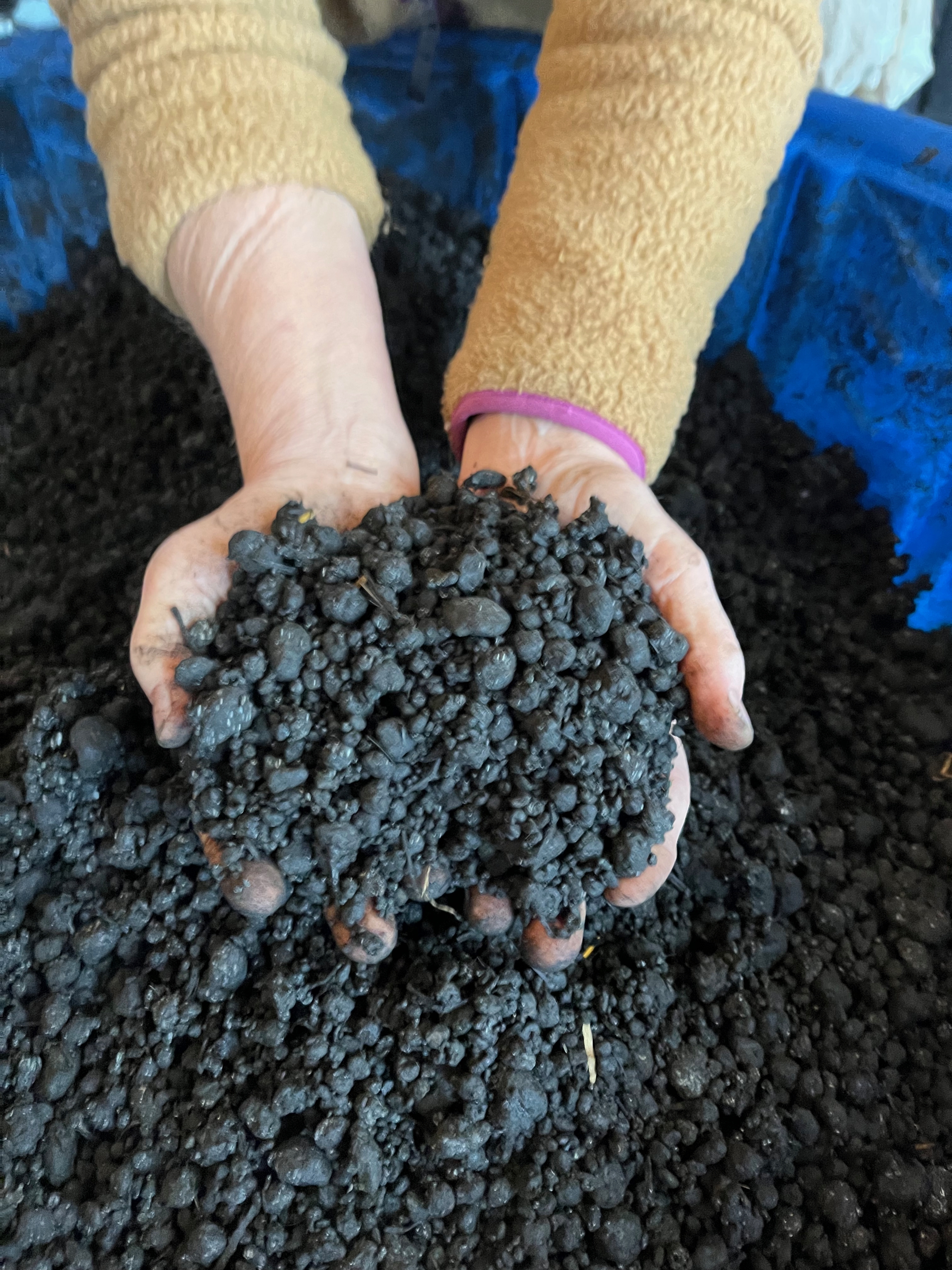
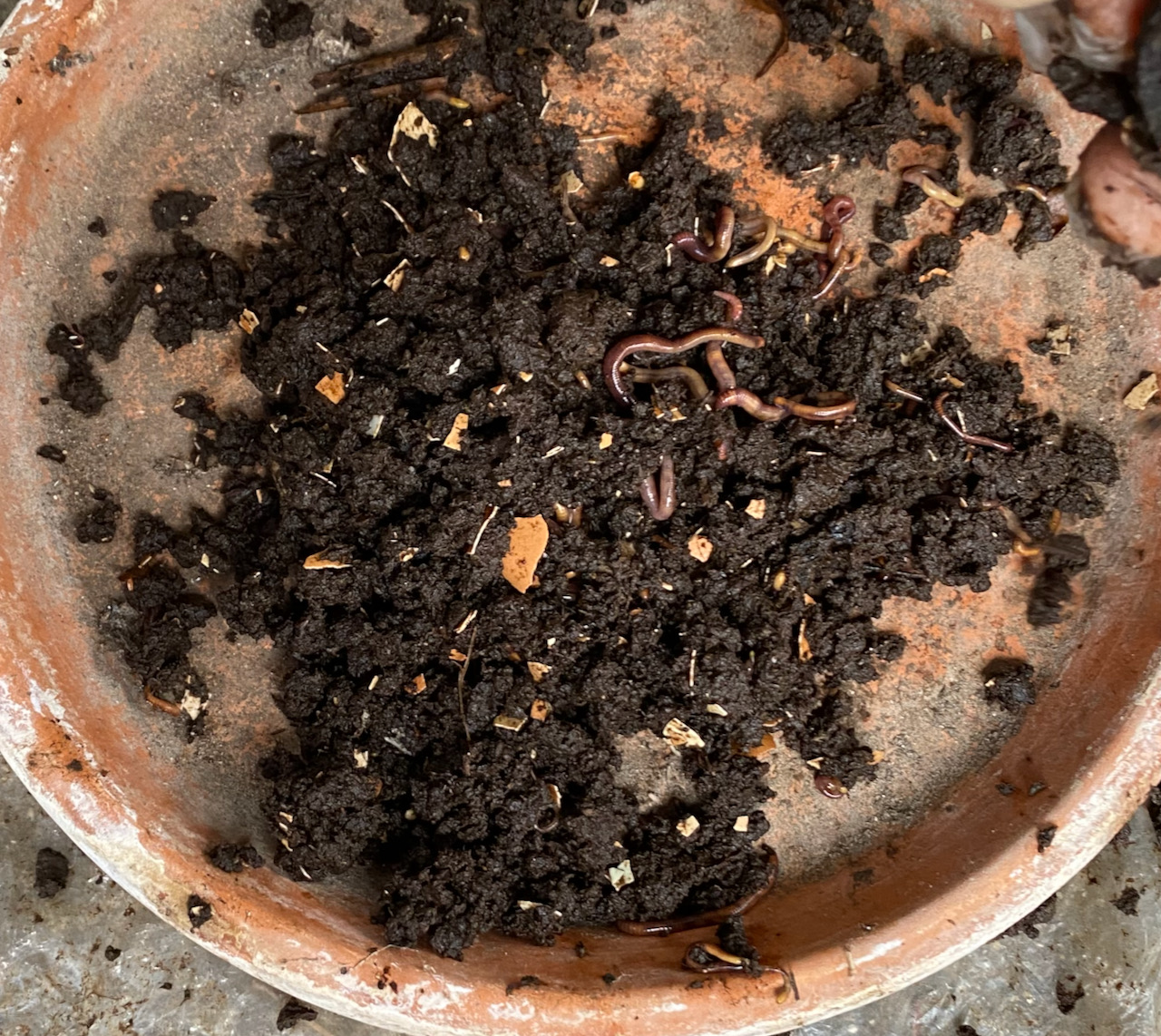
My latest “slow process” is vermiculture. I recently spent an afternoon with friends, sorting worms from castings and beginning my own worm “farm”. This is another of those long term, slow processes that bring me closer to the earth, and makes me appreciate the small miracles of watching things grow. And I know that this compost will feed my indigo plants.

But not everything must be slow….

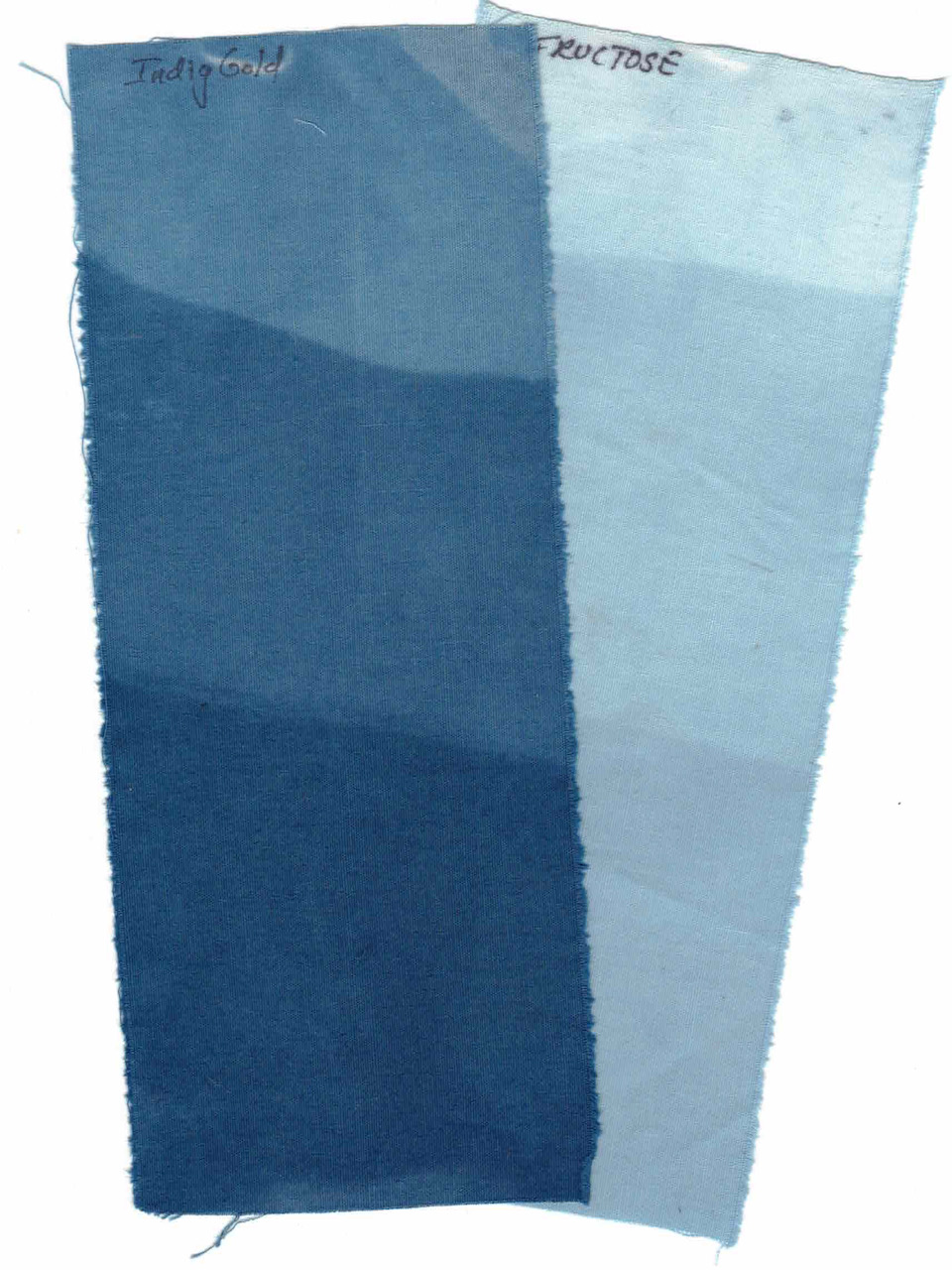
Stony Creek Colors has just released information about their newest product: IndiGold. It is a pre-reduced liquid indigo, grown in Tennessee and designed to be used in combination with fructose and lime (calcium hydroxide). I have dyed with the earlier available pre-reduced indigo but I was never sure exactly what it was and didn’t want to use the reduction chemicals that were recommended. I stopped using that product a long time ago when Michel Garcia introduced us to the “quick reduction” vats made with sugar and lime. But there are some occasions, particularly when teaching a one-day workshop, that it is impossible to make a vat and dye with it on the same day. 

Stony Creek sent me a kit for test dyeing and I was amazed at how quickly the vat was reduced and dyeing to full strength. It took only minutes – not hours. Stony Creek Colors told me that they”skip the chemicals” and use an electric hydrogenation process plus an alkaline to reduce the indigo. There are no chemical reduction agents! I used the vat all day long and it was still in reduction the next day. 

This will not replace my slow, fermentation vats but it will make “quick” dyeing possible when needed. 

Once again, Stony Creek is changing how we think about indigo and its production. They are currently posting information through a Kickstarter Campaign to support this new venture.

The Life of an Indigo Vat

Over the years I have built, used, and discarded many indigo vats. Sometimes I have kept them going for a very long time. I have finally declared the 5 year old, 100 liter henna vat “done”. I have added indigo pigment, lime and additional henna to it many times and although it is still dyeing well, the space available for that dyeing (above the “sludge” at the bottom) has gotten very, very small. 

As many of you know, I have spent this last year at home getting to really know my fermented indigo vats. I have followed a rather strict protocol. Each vat began with a certain amount of indigo pigment, a source of alkalinity (soda ash or wood ash lye) and various plant based materials to begin and sustain the fermentation (wheat bran, madder root, dried indigofera leaves, etc.). Only small amounts of lime and bran have been added over the last year to sustain pH and fermentation. At no time have I added additional indigo.

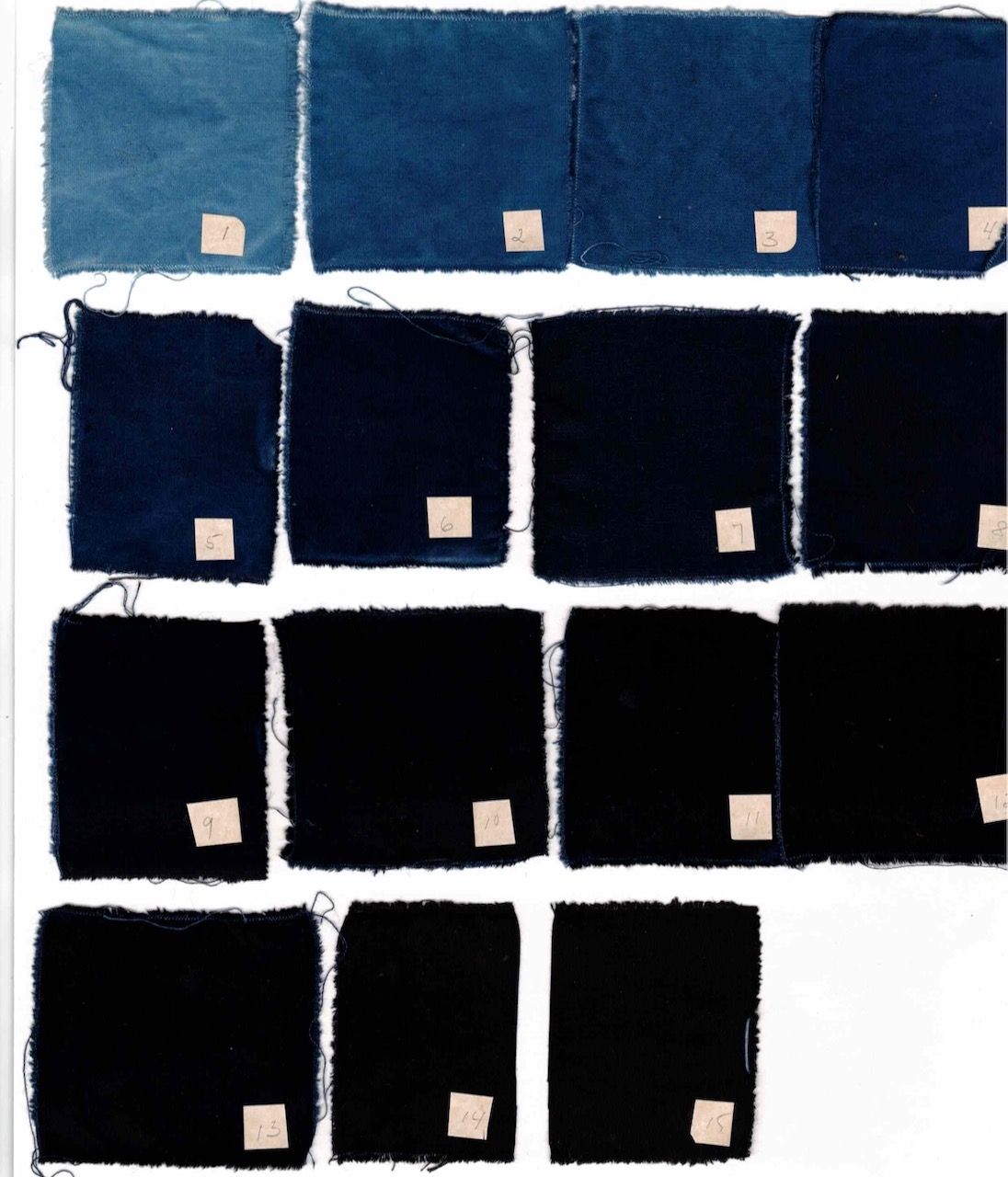
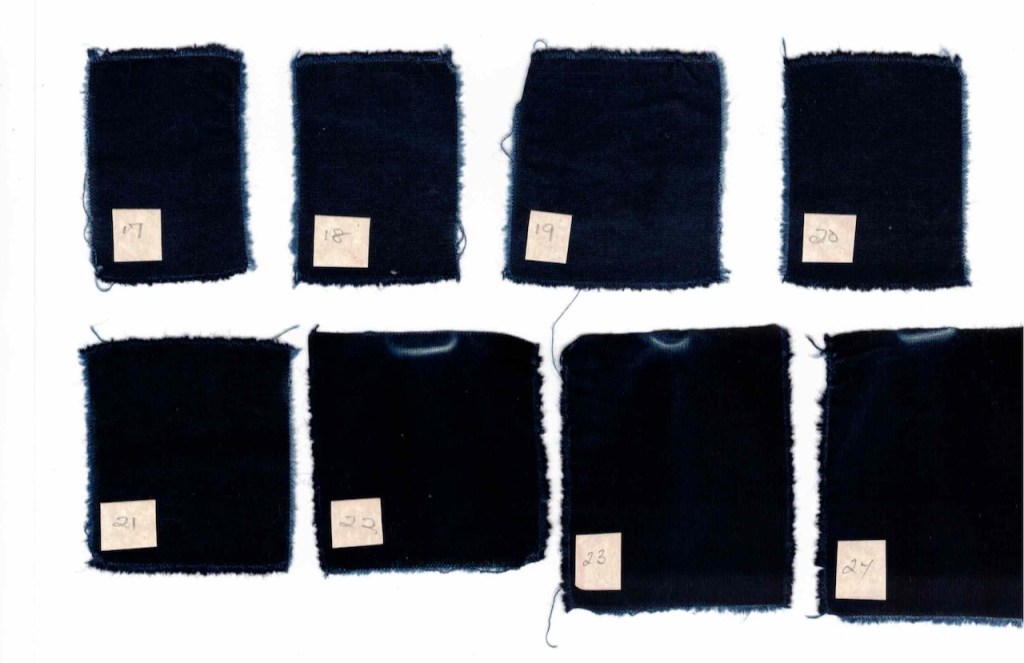
Last May I was trying to achieve a wide range of blue shades from the very palest to very darkest. I was a bit dismayed to find that all of my vats were dyeing too dark to give me the pale shades I desired at the time.  I knew (in theory) that if used the vats enough, the indigo content of the vats would decrease but had no idea how long that would take, or how much dyeing I would need to do. No matter how much I dyed, it didn’t seem to happen.…

Now, a year after the vats were first made, I can see progress.

Indigo on cotton cloth: 1-15 ten-minute dips. May 2020

Indigo on cotton cloth, same vat: 1-24 ten-minute dips. February, 2021

Some observations:

This is a long process….

Two dips in May, 2020 gave the equivalent shade as 5 dips in February, 2021

The dark blue that was achieved from 12 dips in May, 2020 was not achieved, even after 24 dips in February 2021

The subtle differences in the darkest shades are difficult to discern from the photos – but they are there.

I now realize the value of having a number of vats: from old to new, weak to strong. It’s something I have heard Michel Garcia say on more than one occasion, but sometimes we just have to observe and learn the lessons on our own. 

This spring, I will not discard my weakening vats, but will add another vat for the strong, deep blues that I am currently needing to build up black colors on my woven cellulose fabrics.