
It’s been a busy summer, but it’s time to follow up on my earlier post about the recently released Studio Formulas Set dye recipe cards. I received my own set of dye and recipe cards from Schiffer just before Joy Boutrup arrived from Denmark for a class we taught together at Penland School of Crafts in June. Teaching together was a great opportunity to receive some feedback about the set.
Every recipe from the book is represented by a single card. Additonal colored cards illustrate individual dyes and color mixing. We opted to use wool as “the fiber of choice” when creating the initial printed cards as it such a commonly used fiber. The dye cards in the collection document the most important dyes: indigo, madder, cochineal, and weld along with a couple other tannin based dyes.
The dye color cards are beautiful and just as I had imagined they would be. Schiffer did a superb job of reproducing my dyed wool samples in print. Color matching is perfect! I was told that it took several tries to get it just right. I can appreciate that kind of care and accuracy – the same care and precision that I put into my dyeing. Although the cards are durably coated, it is easy to write on them with a ball point pen or ‘Sharpie” and there is room for personalized notes on the back of each card.
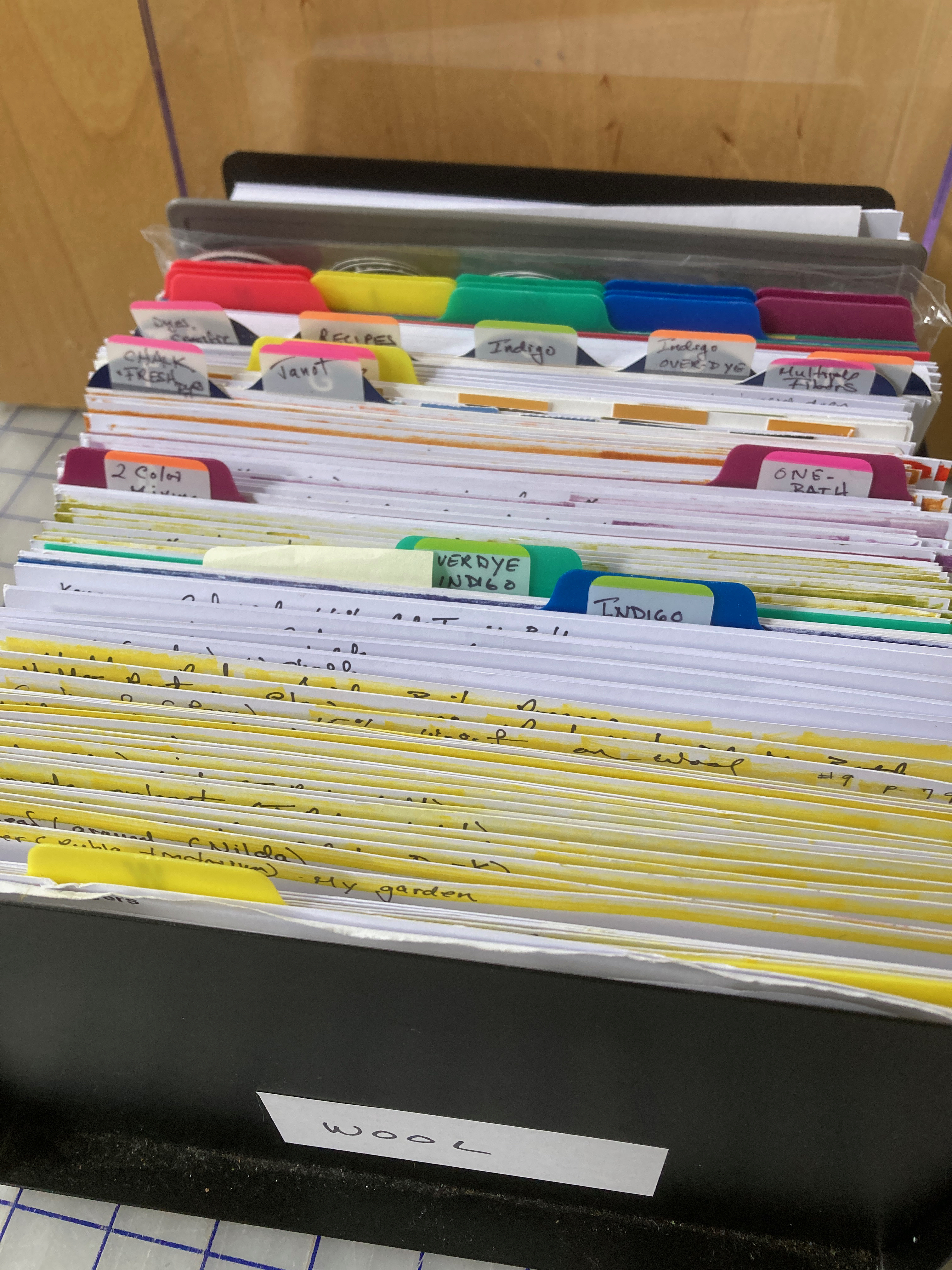
The cards come in a box that is custom made for the set. It even has a magnetic clasp to keep it closed. BUT for me to get the most use out of the cards, I removed the cards from the original box and placed them into a much larger file box. This allows plenty of room for flipping through the various recipe cards, adding tabs for easy reference, AND for adding my own customized cards to the collection. You might want to do the same.
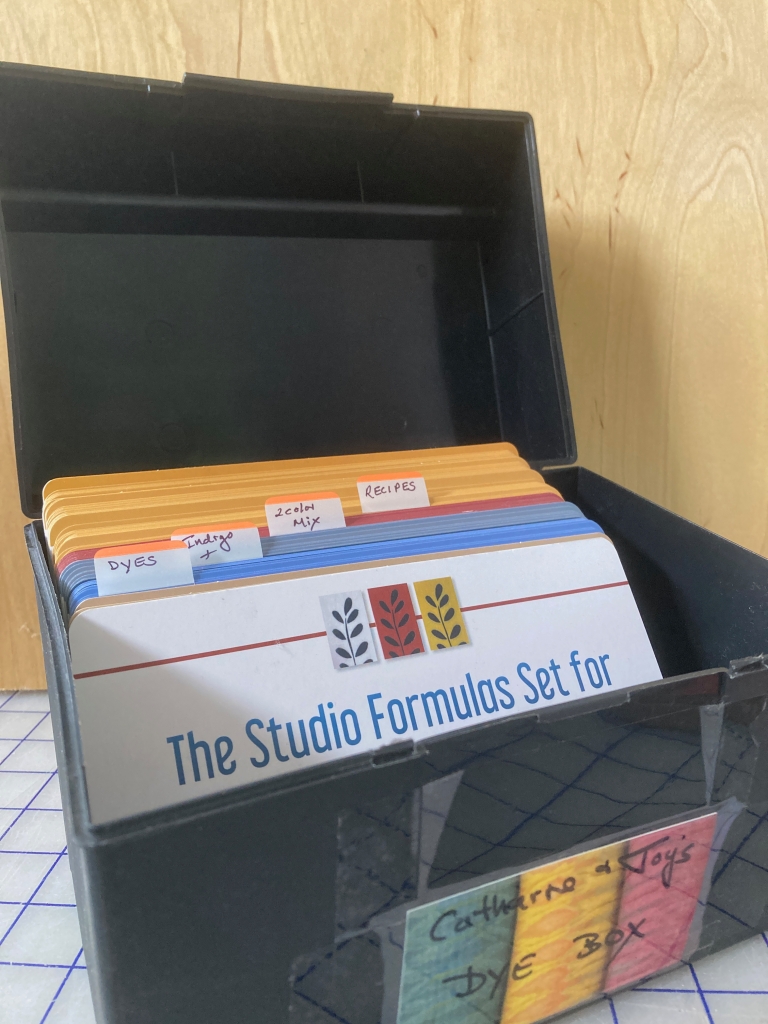
Studio Formulas Set moved into a plastic file box, purchased for less than $10, with lots of room to expand.
Having individually printed recipe cards is proving to be very convenient in my own dye studio. Instead of dripping dye all over my book, I now can pull out the required card and work from that. And, YES, I do use the recipes from the book and I don’t have every one of them memorized!
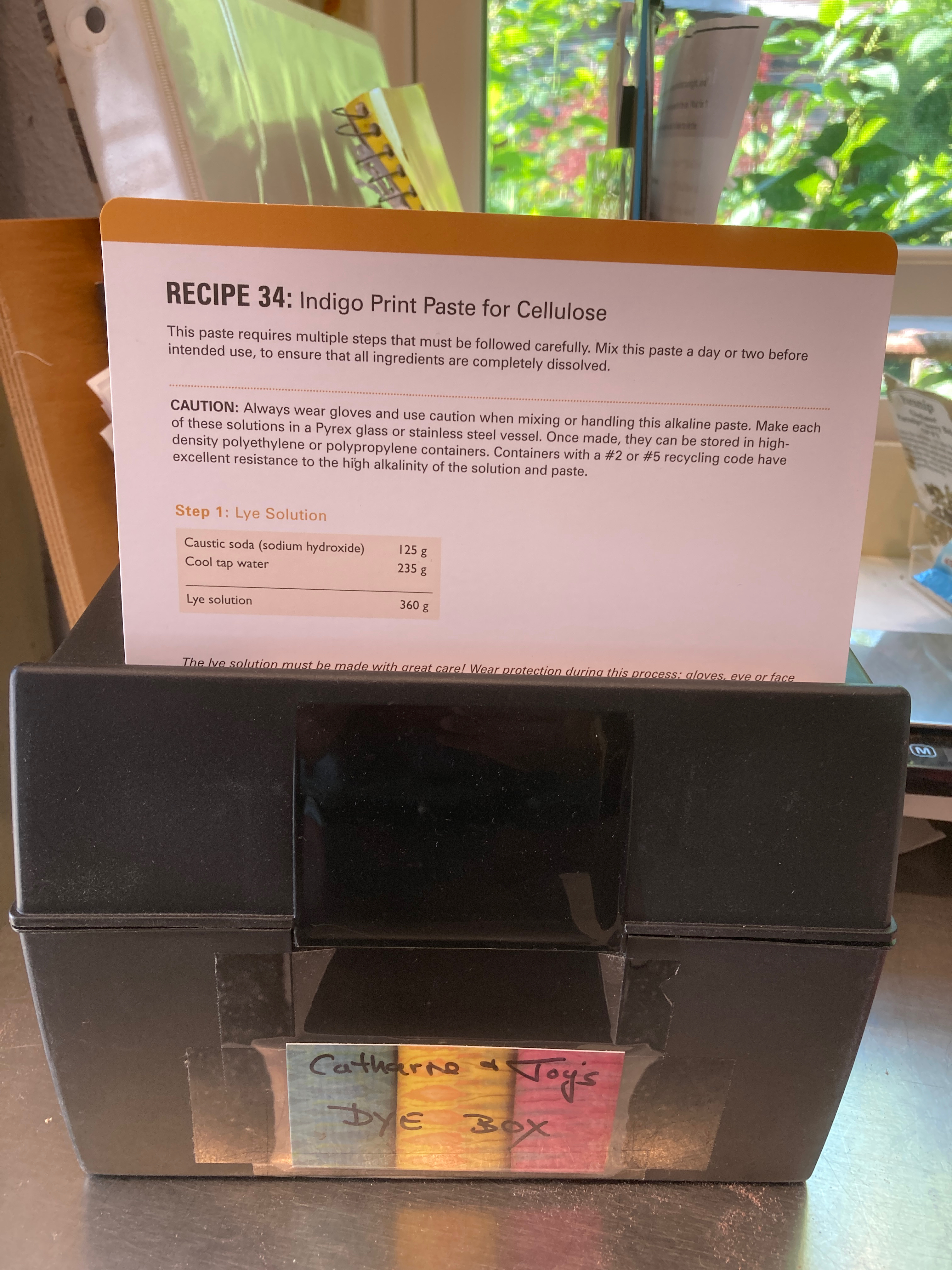
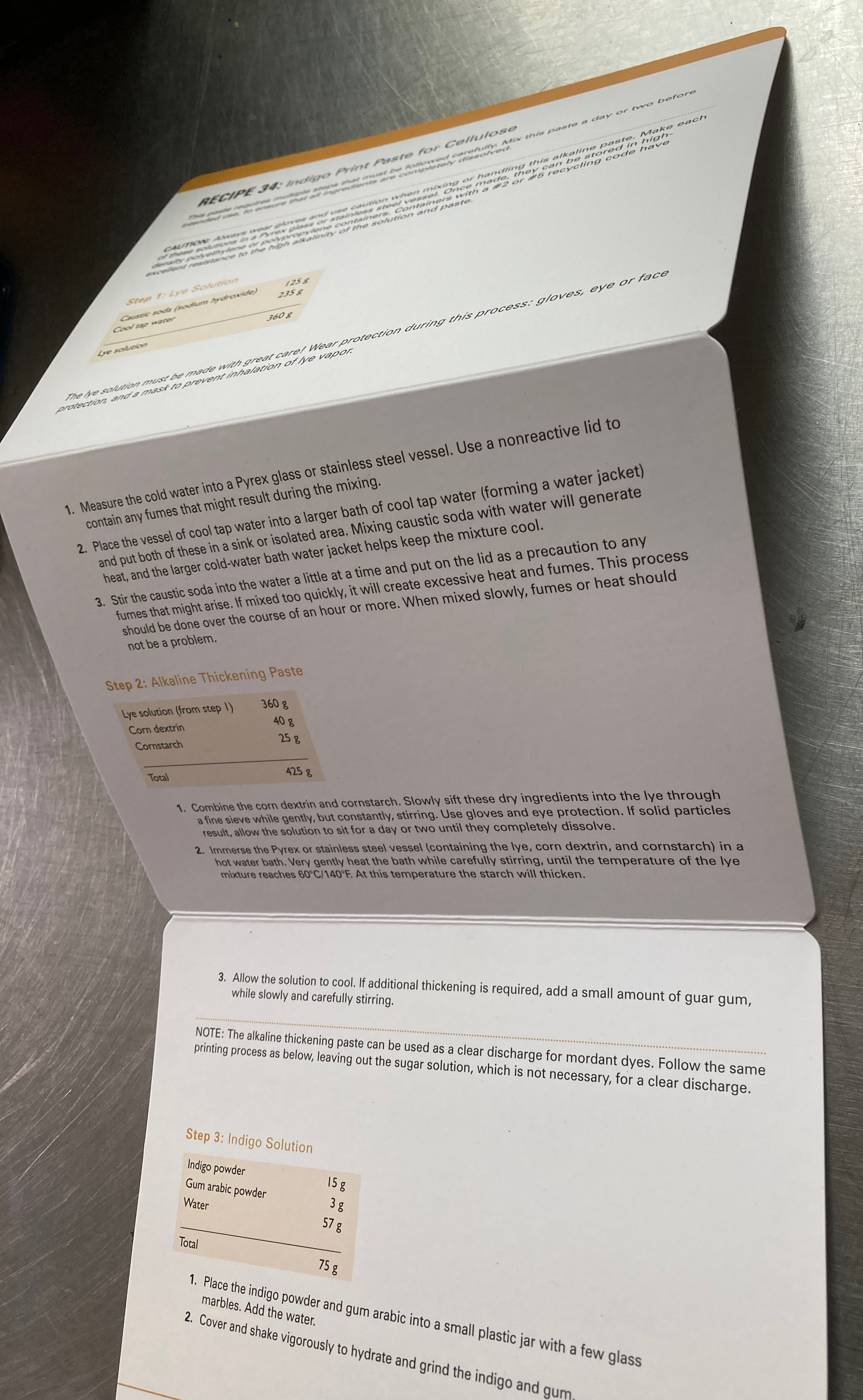
The use of cards containing easily referenced materials and samples has changed the way I work over the last several years. As you know, I am seemingly always testing dyes and process. Once I complete an initial set of tests (recorded in detail with samples in my lab notebook), I then mount the final samples on a card, filed for easy access and reference.
Here is a great example of how useful this process can be:
I recently I went to my dye shelf to look for pomegranate rind for a specific dye project. I found that I had 3 different extracts and two jars of ground pomegranate rind (including one that I had ground myself). Were they different? the same? After making samples of all the various pomegranate dyes (on both cellulose and wool) I can now objectively see the subtle differences between each of these dye sources and make a better informed decision.
Having of a record on hand of the dyes in the studio is an essential discipline that takes the guess work out of the dyeing process. Whenever I obtain a new dyestuff (purchased or grown myself) my goal is to complete a test dye on the appropriate textile material. Sometimes that means dyeing several samples as I explore various depths of shade on different fibers.
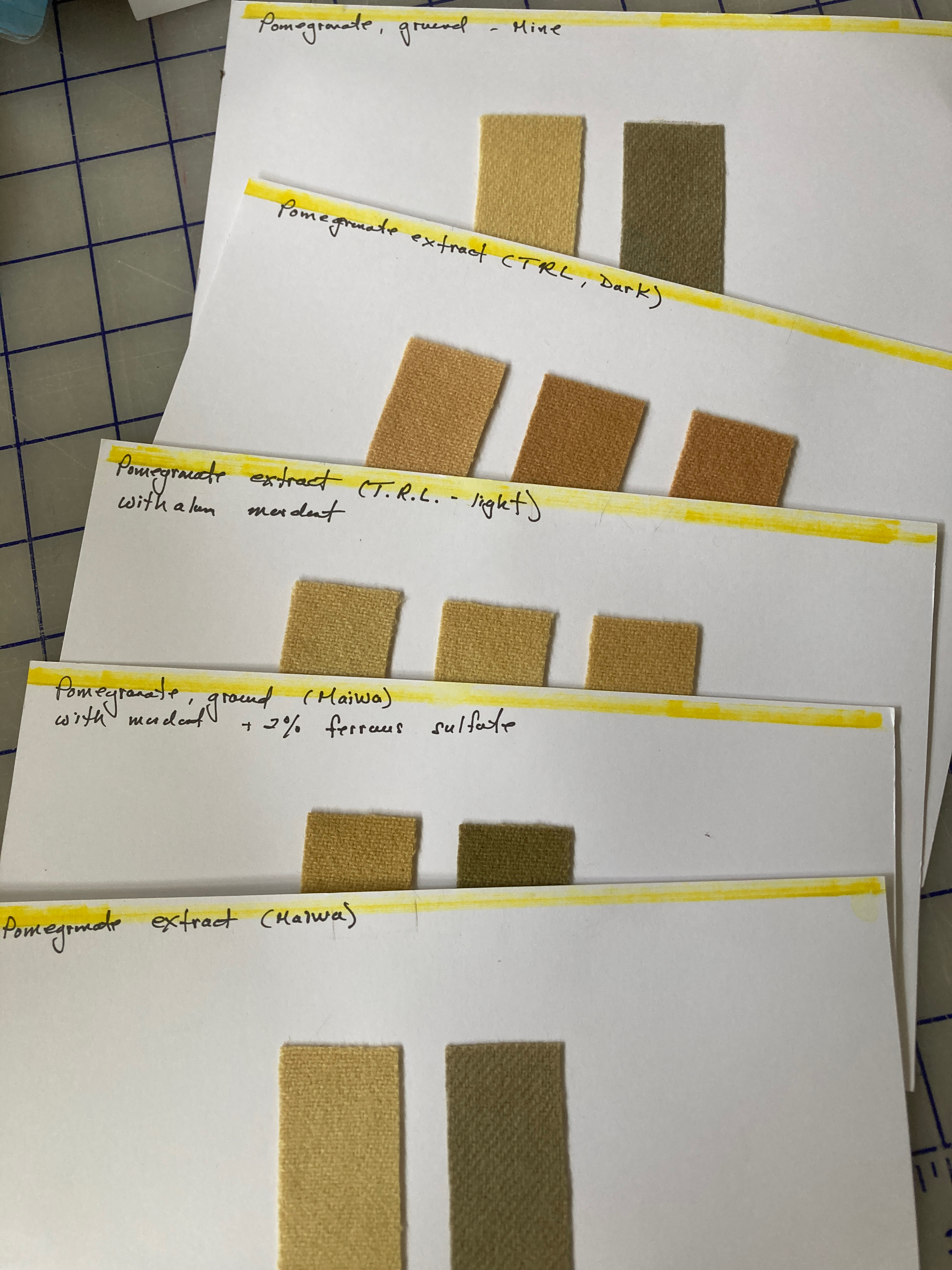
If one chooses to add actual cloth/fiber samples to the box, available space fills quickly. Thus, a larger, file box quickly becomes a necessity. Currently I have one box earmarked for documenting protein fibers and am building another that is dedicated to cellulose.
Careful measurement of the dye used per weight of textile can result in greater control over the palette of color and discourages wasting of dye. It has the potential of bringing natural dye to a level beyond experiment and discovery: controlled color.


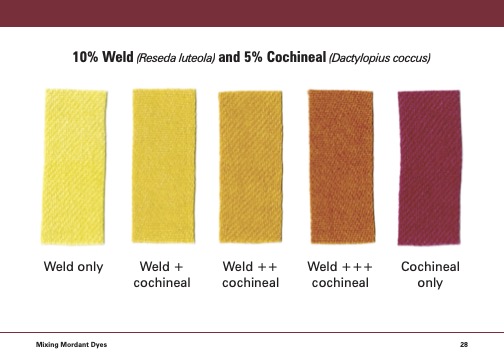

When Joy and I taught together at Penland in June, we used the cards throughout the session as a quick reference for dyeing in the class. By seeing (and understanding) the function of color mixing with natural dyes, students were better able to predict the colors that they would ultimately achieve. I am sure that you will also find them a useful tool in your personal studio practice.
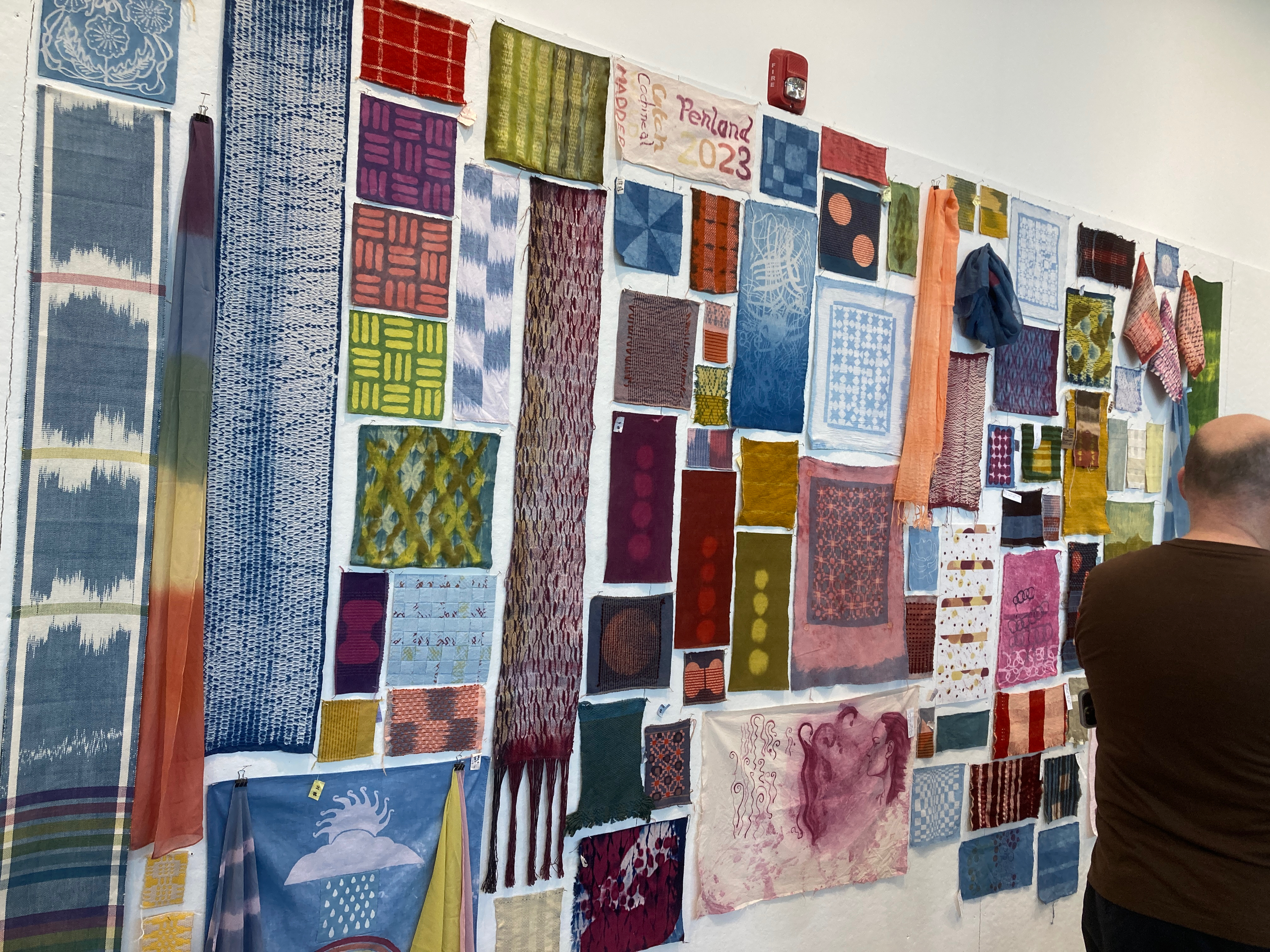
 Natural Dye: Experiments and Results
You Penland class sounds like it created a great deal of excitement for you and Joy
This set is tremendous — the color samples are not just beautiful but so helpful in showing the importance of dye strengths — particularly in mixes with indigo. And demonstrating clearly that great secondary colors can be achieved by dyeing indigo first and then using a mordant dye. Having the recipe cards so easily at hand — invaluable!
I will admit that I have grumbled silently at the close fitting box (lovely to look at, and the magnetic top is good… but trying to find a specific card is tough). I had somewhat guiltily decided to look for a larger box — but you’ve absolved me of that!
Many thanks to you and Joy.
Thanks so much, Elizabeth!
Catharine,
I just ordered my set… I’ve been dripping & splashing on my book and am happy to have your set to add to my own cards… keeping things organized in the studio is such a support for my craft in the studio. Many thanks!! Sarah
Hi Catherine, I love your posts. You touched on something that has irked me about the new card set- the box wasn’t designed to be able to flip through the cards. I was wishing they had made the box bigger with a disposable (recyclable) paper spacer for shipping, to then be removed for use. Perhaps in the next edition….Meanwhile, where did you find the plastic file box you show? Thanks, Jane Laug
I have to admit that I purchased ir from Amazon. The feature I like best is that there is a slot at the top to hold the card that I’m currently using.
Dear Catherine Sorry to bother you but l have a query about Recipe 17 – the one bath acid dye for protein fibres. I have used this recipe several times, always using 10% gallnut extract as it seemed the recipe implied using gallnut extract rather than chopped oak galls. I wonder if it’s possible to use chopped oak galls instead and, if so, what % would be required?Also, would the chopped oak galls/gallnuts need to be simmered first then strained and the liquid then added to the dyebath? Or would the chopped gallnuts be added to the dyebath without simmering them first?I have both your book and the box of recipe cards and they provide an invaluable resource of reliable and comprehensive information for the serious natural dyer and printer. For printers particularly, this is the first book l have come across that offers really useful information and recipes covering all aspects of the use of natural dyes for printing. Thank you. Good wishes Jenny Dean
Sent from the all new AOL app for iOS
Another tannin can certainly be used to replace the gall nut extract. In fact, I have not noticed a significant amount of difference when the same amount of finely ground gall nuts are used vs. the extract. I have also used dried sumac leaves. And no, you do not have to extract the tannin beforehand. Just put it in the pot along with the dyes.
Thank you for your comments, Jenny. As you well know, it is very satisfying to be able to share such a passion with other dyers.
Many thanks for your reply which is very helpful. And thanks again to you and Joy for producing such a great book and to you for sharing your experiences and knowledge on your blog. Good wishes JennyPS Apologies for responding via email but for some reason l don’t understand l can’t respond on your blog without entering a WordPress password, perhaps because l am using my iPhone rather than my PC.
Sent from the all new AOL app for iOS
Dear Catherine, thank you very much for sharing your knowledge and dyeing practices. This article is very interesting, I love dyes, but clearly I’m not that disciplined. Reading it I think I should be more methodical and orderly and follow her instructions. For now, I will treasure her advice. I reiterate my thanks, a hug from Chile, Susana Peñaloza D
Susana, I completley understand that a methodical and disciplined approach to dyeing is not for everyone. Natural dye also lends itself to a more spontaneous approach to obtaining color. But understanding why processes work will certainly improve the chances of success. Catharine
Thank you, your explanation was very helpful. It’s a great idea to expand the recipe box and use it in a way that makes our personal information more accessible
Dear Catherine, thank you for this post, it showed me the importance of keeping good records. I love the idea of the index cards, so this has become a ‘wish list’ item for upcoming Christmas/birthday present from my family. Great idea.
Dear Catherine, such great advice and the recipe card idea is magic. I’ll be saving up to get my set!
Where do you get the plastic storage boxes from for $10?
>
I bought it from Amazon. Either I “mis-remembered” the price or the price went up a bit….but still very affordable and it works very well. https://www.amazon.com/gp/product/B0007894NY/ref=ppx_yo_dt_b_search_asin_title?ie=UTF8&psc=1