
© Catharine Ellis, as posted to the blog: Natural Dye: Experiments and Results
Over the last few weeks, I have posted 12 “lessons” to help dyers who are interested in making their own fermented indigo vat. This is all based on my own experience from the last few years AND very importantly, the guidance I have received from others. These methods, procedures, and formulae have worked well for me over time.
Now it’s up to you, dyers, to make your own vats, observations, and learn by doing. I do not have all the answers, nor do a consider myself an “expert” on fermented indigo vats and I am definitely NOT a dye or indigo chemist. But I am a dyer, who is curious, tenacious, and willing to try lots of things in the quest for learning and best practices for dyeing.
The world of indigo reduction, fermentation and dyeing is very complex. There are so many decisions to make. Each dyer needs to think about and determine what works best for them. One of the comments made to the blog from Sophy Wong said: “root and rhubarb root.–Fructose powder: purified sugar.–Minerals: iron or zinc.–Microbes + fermented plants such as Tspecies in wheat/rice bran or sukumo indigo leaves.–Synthetic.” Yes, Sophy, it’s a zesty mix of options!
So, please, share what you know and learn with others. We are a community of dyers. Although we may have different resources and varying opportunities, we are all searching for the best personal approaches to do our dyeing. It’s only through being generous with other dyers and sharing what we learn that our community will continue to flourish. This isn’t “goodbye” – this is “good dye!”.
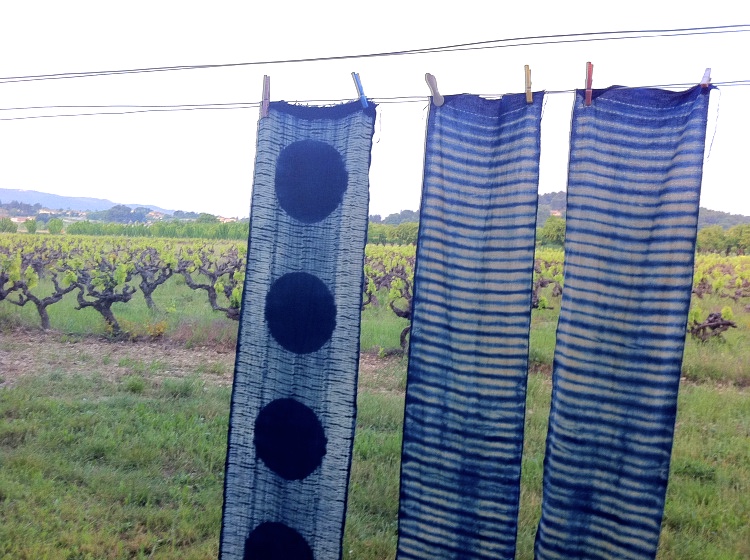
Early indigo dye work with woven shibori. Photographed in Lauris France by Elin Noble
 Natural Dye: Experiments and Results
Again, thank you for your generous sharing of experience. “Tenacious” is definitely the word to describe Indigo enthusiasts! I’m looking forward to pouring over your words in the days ahead as I harvest my little plot. Ever hopeful that I will see some blue this season 💙🩵
Thank you so much for sharing your knowledge. I have learned so much and now can address some of the issues I’ve encountered with my past two years of indigo dyeing. It is such a fascinating process and I’ve loved making different dye vats. I have a bag of Sukumo from Aikuma Japan and this is how I found your posts. Perfect timing. I can’t thank you enough!! I also found your January 2020 helpful.
Thank you for all your comments and guidance. I started my vat yesterday and am excited to see where it goes.
Hi Catharine Thank you for sharing. I have been experimenting with woad over the years and always thought I didn’t know enough about it to share. You have made me realize that I do have something to share. So I will. Trish Van Huesen Bloomfield Ontario
Hi Catherine,
I just wanted to say a huge thank you for these posts. I have saved each one and am looking forward to experimenting when work pressures die down a bit. I have so appreciated your approach which has definitely informed and shaped my own. I got into so much trouble as a child asking ‘why’, but now it stands me in such good stead as a hobby-dyer. ‘What will happen if’ is such a delight. Will it work better if… what if I… ‘If’ is such a great thought.
With best wishes,
Sue
Thank you for all the wonderful posts on fermentation vats!
In the spirit of sharing knowledge, I don’t think I’ve seen this oddity of calcium hydroxide discussed in the world of indigo dyeing: it is counterintuitively most soluble at cold temperatures. If you have an excess of Ca(OH)2 at room temperature, the pH is actually too high for leucoindigo to properly bind to cellulose fibers. It has to be heated to at least 40°C/104°F to get below pH 12.
On page 4 of this document put out by the National Lime Association there’s a chart with more detailed information:
Click to access lime-physical-chemical.pdf
Thanks. I’m going to have to think about this for a bit…..
Thank you very much for sharing your knowledge—it’s truly appreciated. Based on your insights, I decided to start over with a fermentation vat after a previously disappointing attempt. This time, the process went smoothly, and I’m getting fantastic results.
Is it correct that the blue appears more vivid with fermentation vat than in a reduction vat? I always had that impression when working with different reduction vats, but now I feel like I’m finally achieving the rich, authentic indigo blue I’ve been aiming for.
Many thanks again!
Kristin
This is good news! Thanks for sharing it.
THANK YOU! For tirelessly sharing your learnings with us. Because of your supportive and detailed blog I sized up my Indigo vat from a small container (15 L) to a small pail with lid of 30 gallons, bought an aquarium heater (still rethinking this one) and experimented on a bigger scaled with different types of fructose for my organic vat. A banana mash works best for me and surprisingly has managed to last and keep on giving for 8+months now! I suspect it’s end may be near though!
Hi Catherine, Thanks for all of your info and experiments with indigo that you are willing to share. Is the rhubarb root the same as what we eat from our garden and is the dock, curly dock a plant that grows wild where I live. Thanks Debbie Cooter
>
Yes, it is the same rhubarb root, but ordinarily I leave those roots in the garden unless I need to thin them out. For dyeing, I typically purchase “medicinal” rhubarb such as Rheum palmatum or Rheum officinale, which can be purchased already ground. And yes, the dock root is the same as the one that grows everywhere. It’s the long tap root that is used – and a challenge to remove, so once again, I typically purchase Rumex crispus,or some other ground medinincal variety that is already ground. Both of these roots also yield a good yellow dye for protein without a mordant, using the “one bath acid” approach to dyeing.